Writing

Posts about writing.

Obligatory NaNoWriMo Post

NaNoWriMo approaches!

Before you ask, yes, I’ll be attempting the 50k word novelling challenge this year. I attempt it pretty much every year, although I haven’t succeeded since 2010 (when I wrote the first half of Chasing Nonconformity).

My novel project this year will be the third book in the Imminent Danger series, hesitantly titled “Cerulean Bound”. Make of that what you will.

I don’t expect to make it all the way to 50k, but I figure that even if I only do 10k, that’s 10k more than I had before, so what the heck!

My username is Grand Admiral Chelli — feel free to add me as a writing buddy, come say hi, etc.

This concludes my statement. Have a glorious Wednesday!


Unrelated media of the day:

When sexting goes wrong …

Categories: Writing | Tags: , , | 14 Comments

Editing Tip: 10 Ways to Get Past the First Chapter

We shall begin today’s lesson with a personal anecdote.

My current goal is to edit Chasing Nonconformity. This is going very poorly, because every time I sit down and open up the file, it begins on page 1 — also known as Chapter One. Now, logic dictates I would just skip ahead in the document to wherever I need to edit and go from there. But before I do that, I happen to notice a slight re-wording I can do on paragraph three. Okay, that’s better … oh, but I don’t like how Eris rolls her eyes in paragraph five. And I missed a comma in paragraph 7 … maybe I should keep reading …

Three hours later, Chapter One has completely changed for the zillionth time and I’m no closer to finishing the darn draft than when I started.

As I’m learning, the trick to editing a book is to get past the first chapter. Once you’ve broken through that barrier, sky’s the limit! No, I take that back. There is no limit. The first chapter is a pair of steel shackles and you are the Hulk, summoning up your anger, stoking the fires of your wrath, bigger and hotter and higher and flamier until BOOM! Free of the shackles, free of the first chapter, ready to show the rest of your story who’s boss. (relevant link)

Thus, I present to you …

10 Ways to Get Past the First Chapter

  1. Highlight Chapter 1, cut it, and paste it at the end of your document so it isn’t the first thing you see.
  2. Never turn off your computer or close your document file so you can always keep your place in the manuscript.
  3. Hire someone to slap you in the face with a lightly salted salmon fillet every time you try to edit Chapter 1.
  4. Change the font color of Chapter 1 to white text so you can’t see it.
  5. Search “Chapter 2” and don’t look at the screen until you know you’re in the right place.
  6. Hire someone to slap you in the face with a braised lamb shank every time you try to sneak back to edit Chapter 1 whilst pretending to edit the rest of the manuscript.
  7. Hire someone to scream directly in your ear every time Chapter 1 appears on-screen in order to mentally connect the first chapter with complete terror.
  8. Commit a crime and go to jail. Hard to edit Chapter 1 without a computer.
  9. Hire that guy from Inception to sneak into your mind and brainwash you into forgetting Chapter 1 exists.
  10. Summon up some basic willpower and just skip the first chapter.

As you can see, some are more practical than others. I myself will be starting with #3. I wanted to go with #6, but lamb is significantly more expensive than salmon and I am poor.

Thank you for sharing in my madness. For all those Canadians out there, Happy Thanksgiving!


Unrelated media of the day:

Categories: Writing | Tags: , , , , , | 35 Comments

My Mother’s Sassy “Letter to the Editor” Jabberwocky Poem

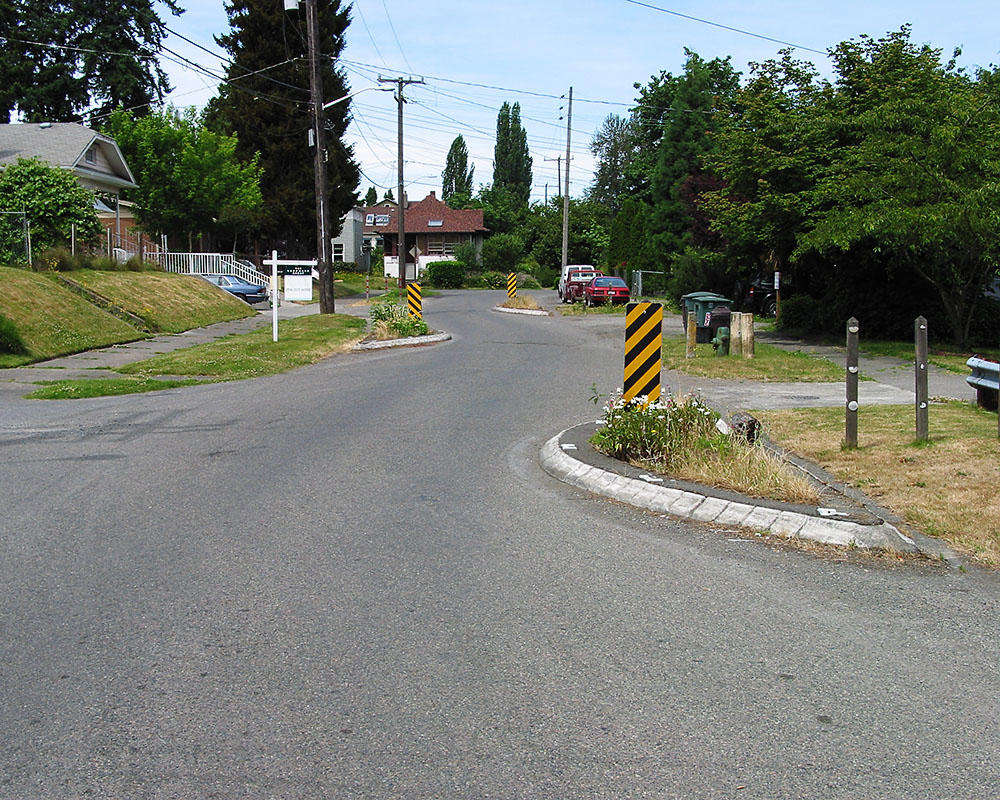
Does everyone know what a “chicane” is? Essentially, it’s a curvy bit of sidewalk they put on a road to force traffic to slow down. See the below image:

So those round bits of pavement with the yellow caution signs are chicanes.

In my hometown of Aurora, the local government went absolutely crazy with chicanes. They were tired of people cutting through a quiet neighborhood to get from one major road to the other, so they ripped up the streets and infested them with literally dozens of chicanes. It’s practically a go-kart track if you try to drive through there now.

Naturally, no one actually slows down — they just zoom down the middle of the road. But the chicanes were irritating enough — and enough of a waste of taxpayer money — to prompt my mother, back in 2008, to write an ultra sassy version of the Jabberwocky by Lewis Carroll and send it in to The Auroran (the local newspaper). I found it quite amusing, and hopefully you will too!

Without further ado …

Aurorawocky

Categories: Writing | Tags: , , , , , , | 11 Comments

Chasing Nonconformity Back Cover Blurb – Help!

Happy Saturday, everyone! As edits are progressing well with Chasing Nonconformity (Imminent Danger #2), I thought it high time to share the back cover blurb with you!

The story is set but the blurb isn’t, so if you have any suggestions for how to improve it, please by all means comment! Actually, that’s exactly why I’m sharing this today, so please let me know what you think. Heck, if you want to re-write it entirely, that’s “totes” cool with me.

Without further ado …

Chasing Nonconformity

(Imminent Danger #2)

Back cover blurb

Still recovering from the shock of accidentally marrying an exiled alien prince named
Varrin, and from almost getting her head blown off by a six-armed lizard man with anger
management issues, seventeen-year-old Eris Miller is ready for a vacation. But Varrin is
desperate to rescue his beloved spaceship, the Nonconformity, from the clutches of the
galactic government, so her vacation will just have to wait.

While Eris and Varrin chase after the stolen ship, they are unaware that trouble is
brewing on the other side of the galaxy. The villainous Emperor of Rakor has assembled
an unlikely team to hunt down and capture Varrin: Prince Trystan (Varrin’s younger
brother), Sebara (Trystan’s electro-scimitar-wielding bodyguard), and Fino’jin
(commander of the deadly Skin Slicers).

With enemies closing in, time running out, and the Nonconformity slipping further and
further from their grasp, Eris is forced to ask herself … what is she willing to sacrifice to
ensure her happily ever after?


There we have it! Comment, comment, comment, and my thanks in advance for any and all help provided.


Unrelated media of the day:

John Oliver tears into the Miss America pageant and it’s hilarious.

Categories: My Works, Writing | Tags: , , , , , , , , | 21 Comments

How to Edit a Novel in 10 Easy Steps

For today’s post, we’re going to delve into the distressing topic of editing. Why distressing? Because I hate editing. But you don’t have to follow in my somewhere-between-size-9.5-and-10 footsteps! Not with this handy guide …


How to edit a novel in 10 easy steps

  1. Write a novel. You’d think this step is obvious. You’d be right.
  2. Read the novel through and take notes. We’re talking big picture notes here, not spelling mistakes. What do you like? What do you not like? Which characters are interesting and well developed? Which aren’t? Which parts of the story are exciting? Which parts bore the pants off you? Tip: If you’re not wearing pants, put some on, and then see which parts bore them off you.
  3. Re-write your novel. Not the whole thing, necessarily, but as much as you need to in order to fix the problems you identified in step 2. If you didn’t identify any problems in step 2, you’re an adorable little ray of sunshine and you need to get with the program because first drafts are always terrible and if you can’t find at least one thing to fix, we need to have a serious chat.
  4. Give your novel to a trusted friend to read. Ideally, you want to find someone who is both able to provide useful, constructive feedback, as well as able to do so in a manner that doesn’t make you want to curl up into a ball and cry for three months straight. Good luck.
  5. Discuss your novel with the trusted friend. Discuss it at length. Preferably for multiple hours over multiple sessions. You want to hammer out exactly what they liked and what they didn’t, what they think worked and what didn’t, and so on and so forth.
  6. Re-write your novel. You’re still focused on the big picture right now. Make sure you’re consistently spelling your protagonist’s name right later.
  7. Give your novel to a group of beta readers. Again, you want people who are readers in your genre, who know what a book in your genre is supposed to look like, and who are (hopefully) able to explain to you how your book stacks up in comparison. And if it doesn’t stack up, they should be able to tell you why.
  8. Re-write your novel. You know the drill.
  9. Focus on the details. Woo! Best part of the process! Or possibly the worst! You’re almost done now — you just need to make sure everything flows smoothly. Look for inconsistencies, logical flaws, make sure characters don’t randomly change their eye color halfway through, etc. Check your grammar, check your spelling, check your point of view, check your tense (past, present, etc.). If you know anyone who’s good at proofreading, get them in on this step, because doing it by yourself takes forever and you’ll definitely miss something.
  10. Run a spell check. Oh, don’t look at me like that. You’d be shocked how many books have random typos that could have easily been picked up by a simple spell check. Run it. You won’t regret it.

Now, obviously you may need to repeat some of the steps several times. I, for example, like to re-write my books five or six times before I even get to the beta reader stage. But this is the basic process I follow — and now, so can you!

What’s your editing process? Tell me!!!


Unrelated media of the day:

Categories: Writing | Tags: , , , , , | 36 Comments

Hip Hurrah for Editing!

That was a misleading title. I hate editing. It takes forever and it’s tedious and when you have to cut chunks of text it’s soul-crushing. That being said, it’s necessary, and it’s currently the next step I have to take if I ever want to publish Chasing Nonconformity. Thus, I edit!

I’ve been putting it off for several months now, and sometime last week I just got tired of seeing the manuscript sitting on my bedside table. I think my sudden burst of excitement for editing has come about partially because I’ve been playing around with formatting the interior for Imminent Danger. As you may or may not know, I intend to re-publish Imminent Danger in the near future via Amazon KDP (and Createspace), so I’m starting to look into exactly how I’ll go about doing that.

The key to editing for me, I think, is that I just need to get into the writing mood. It doesn’t matter how I get there, but once I’m in, I can force myself to direct my energy toward whichever project needs attention — in this case, Chasing Nonconformity.

As of today, I have finished addressing my editor’s notes on the latest draft. I am now preparing myself to go through the manuscript again, with the intent of ironing out inconsistencies and attempting to cut the manuscript down to size. It’s currently sitting at around 115k words, which is much too long. As you may remember, however, Imminent Danger was once at 120k words, and I got it down to 94k, so I’m cautiously hopefully I can repeat that feat here.

If anyone has any words of wisdom or encouragement for me as I delve back into editing my magnum opus (ha!), please share them with me in the comments below.


Unrelated media of the day:

Categories: My Works, Writing | Tags: , , , , , | 33 Comments

Fight! Critique group vs. critique group

This past Friday, my Nova Scotia cousin kindly invited me to her long-standing critique group, since she knew I was new to the province and desperately need to get myself up-to-speed with the local writing scene. As we gathered around the living room with glasses of wine and freshly baked bread, it occurred to me that the experience was vastly different from my critique group in London. I can see pros and cons to both sides, which has led me to …

Fight! Critique group vs. critique group MORTAL KOMBAT TO THE DEATH!

Round 1 Challenger: London, Ontario Critique Group

Pros

  • Monday meet-ups from 7-10 — This allowed me the whole weekend to finish up our pieces, as well as gave me something to look forward to on a dreary Monday
  • 2-3 pieces read aloud, then critiqued — This A) meant I didn’t have to spend time reading the pieces before the group, and B) gave us lots of time to explore the piece in depth, providing a more thorough critique

Cons

  • If any one piece was dull, it meant a full hour of dullness
  • If the reader read their piece aloud too quickly, it was hard to follow and I got confused
  • I couldn’t help but make minor grammatical and spelling corrections along the way, making it harder to focus on the big picture elements

Round 2 Challenger: Halifax, Nova Scotia Critique Group

Pros

  • Friday meet-ups from 8-11 — This means I don’t have to worry about having energy the next day, as it’s a Friday! On the other hand, I get tired easily, so 11 is pushing it a little late
  • Send pieces by email beforehand, then discuss at group — This means A) upwards of 5 people can get their work critiqued over the course of the evening, and B) we don’t have to print off 40+ pages if we want a piece critiqued

Cons

  • Without the piece in front of me, I sometimes forgot why I had written down a specific piece of criticism — meaning my critique was less in-depth as a result
  • Some of the submitted pieces were novels, meaning we just read what we can each week — This means, however, that different people are at different points in the story, meaning I can’t follow half the critiques because I don’t know what the heck they’re talking about
  • Sometimes I really need that extra few hours before the meet-up to put the finishing touches on my piece — but then I would submit it so late, no one would have a chance to read!

Time! Winner … undecided?


Thoughts on my pros/cons list, and which style of group is better? What’s the best critique group you’ve been in, and how did it run? Inquiring minds want to know!


Unrelated media of the day:

Categories: Writing | Tags: , , , | 19 Comments

Day 3 (final day!) of my Halifax Road Trip

Sunday

The gentle patter of rain in the shower awakens me at an ungodly hour. Mother emerges from the washroom at 9:45. Our scheduled departure is 10:00. Defeat is already inevitable.

I shower and dress and gather my things and before I know it, the time is 10:40. Damn it all. I rush down the stairs and out to the parking lot, where everyone is waiting for me. They have the decency not to call me on my lateness, but we all know the truth. Once on the highway, mother breaks our sacred vow of silence and tells me I was late, and that the others weren’t. I brood for a few minutes, and then drown my sorrows in local radio babble.

Lunch falls at a far more opportune time today for my poor growling stomach, and we break for gas and tasty A&W root beer and burgers. I apologize to my companions for my lateness. The lead car driver agrees that I was late, and points out that I am notorious for being late. I agree with this assessment, apologize again, and all is forgiven.

We’re nearing Nova Scotia now, and our lead car driver professes her desire to sit in the truck with her husband as we cross the border and enter our new homeland. I am agreeable to this, so mother takes over driving the lead car (soon to be the last car, as the truck will now go first in our caravan). The truck driver’s companion abandons her post and joins me in my ancient Mazda. I can only pray that the poor little thing makes it all the way to Halifax with all parts intact.

We speed along the highway, and as the road curves and twists, a new form of entertainment emerges. As the last car in our caravan now, it is mother’s duty to defend us from filthy tailgaters and their evil ways. A challenger approaches: a white car who disapproves of the slow pace we’ve set on this one-lane road. He gets up close to mother. Mother, accepting this unspoken challenge, slows down slightly to warn him off. Irate at her challenge to his vehicular supremacy, the white car draws closer. She of infinite patience slows further. This continues for some time. I am amused.

A two-lane segment of road approaches! My travelling companion and I are thrilled, for this will surely break the stalemate. But such reprieve is not to be, for the white car and mother are now locked in a duel that only death itself can end. The white car refuses to pass in the new lane, hugging mother’s bumper like my roommate’s cats when they cuddle. Mother refuses to move into the new lane to get out of his way, and slows even more. We can barely see her in the mirrors now. Soon she will vanish from the world entirely. We cheer her on.

At some point the white car turns off, and mother emerges victorious. We have little time to celebrate, though — the border to Nova Scotia approaches. It’s magnificent, with huge windmills and gardens and a welcome center and a cheery sign. We are impressed, partially by the beautiful welcoming to our new home, and partially because we actually noticed that we’d entered the province (unlike the New Brunswick/Quebec border, which is just pathetic).

Onwards and upwards into Nova Scotia we fly, and the road signs count down the kilometres to Halifax. Closer and closer, faster and faster … and then … VICTORY! We turn off, we drive, we turn again, and a cozy red brick townhouse looms up on the left: our new home. Our landlord greets us and takes us inside. Plush carpeting, a cute kitchen, an expansive deck, and an unnecessary amount of stairs are ours to explore and claim.

We haul the truck door open and carry in our mattresses. The true unloading will take place tomorrow, but for now a place to sleep is our only thought. We wrestle a king-sized mattress up the twisting staircase, cursing and sweating and bonding over our shared physical exertion and exhaustion.

Once all mattresses are in place, we head down to the waterfront for dinner, drinks, and good company. My uncle joins us, and regales us with stories as we consume assorted seafood. After dinner, we walk along the boardwalk eating icecream and taking in the sights. We stop at the end of a dock and admire the dark, sparkling waters of our new home. And then we return to the townhouse to sleep and recharge and refresh, ready and excited to face the days ahead.


Unrelated media of the day:


Categories: Random, Writing | Tags: , , , , , , , , | 7 Comments

Writing Tip: Dialogue Tag DOs and DON’Ts

Today we’re talking about dialogue tags! I already rambled about them in a previous post, but I’m going to ramble some more about them now, so prepare yourself.


What is a dialogue tag?

It’s the short phrase you stick after a line of dialogue — i.e., “he said”, “she said”, etc.


Simple dialogue tag

Observe the following sentence:

“I love your socks,” he said.

That’s a simple dialogue tag — sentence of dialogue, followed by a dialogue tag. Here are some more:

“Your face is on fire!” she said.

“Are you sure?” he said.

Note:

  • You have to use a punctuation mark at the end of the sentence of dialogue that’s not a period — i.e., comma (most common), question mark (for questions), exclamation mark (for excitement!) — Using a period is effectively ending the sentence, so if you put a period after “I love your socks”, you’re ending the sentence, and then the “he said” is just randomly floating there with no attachment to anything
  • The “he said” or “she said” needs to be decapitalized. If you write something like this — “I love your socks,” He said. — you’re indicating by capitalizing the “he” that either A) God is talking, or B) you’re starting a new sentence and don’t know how to punctuate your sentence of dialogue properly.


Dialogue tag before dialogue

Observe:

Staring at her beautiful face, he said, “I’d like to lick your nose.”

So here we’re reversing the order of dialogue and dialogue tag. Note:

  • You need to end the dialogue tag (and thus lead into the dialogue) with a comma or a colon — not a period, question mark, or exclamation mark. Using one of those would indicate the sentence is ending after the word “said”, which means you have a sentence reading: “Staring at her beautiful face, he said.”, which makes no sense at all


Dialogue tag in between two pieces of dialogue

Observe:

“How are you doing?” he asked. “Isn’t the weather grand?”

“I wish I could agree with you,” she said, “but I have a ferret up my nose.”

Here we have two variations of “dialogue tag between two pieces of dialogue”. In the first example, we’ve got dialogue with a complete sentence (How are you doing?), and then a second complete sentence of dialogue (Isn’t the weather grand?). Since these are both complete sentences, we put a period after “he asked”. In the second example, the second bit of dialogue is continuing the first bit of dialogue, thus we stick a comma after “she said” to indicate the sentence is still on-going.


Using a descriptive sentence instead of a dialogue tag

Observe:

Tracy cleared her throat. “Excuse me, can I please have one albatross-egg omelette, shaken not stirred?”

So here we know that Tracy is speaking, since the first sentence implies fairly heavily that she’s the one talking. It’s not a dialogue tag, because it’s not describing how she’s talking — you can “say”, or “exclaim”, or even “screech” out a sentence, but you certainly can’t “clear your throat” a sentence.

You can also stick the descriptive sentence after the dialogue:

“Where are you going?” Mary pouted at Roger, hoping he would come back and stay with her forever.

Again, “Mary pouted” isn’t a dialogue tag, because you can’t “pout” a sentence. It’s a sentence unrelated to the dialogue, although it still indicates she’s the one talking.

Third example, putting a descriptive sentence between two dialogues:

“My name is Jim.” I’m lying through my teeth, but she doesn’t need to know that. “What’s your name?”

Note:

  • First rule here is that you can’t punctuate dialogue tags and descriptive sentences the same way. If it’s a dialogue tag, it’s attached to the dialogue. If it’s a descriptive sentence, it’s a different sentence entirely from the dialogue. This means you can’t do something like this:

“Hey Bob,” I shake his hand, “what’s cooking?”

  • This is wrong on so many levels. Can you spot them? A) “I shake his hand” isn’t a dialogue tag, so “Hey Bob” should be ending in a period/exclamation mark to indicate the sentence is over ; B) “I shake his hand” needs to end in a period, since it’s a sentence, and sentences don’t end in commas! ; and C) “what’s cooking?” should have “what” capitalized, since it’s the start of a sentence


In conclusion …

Dialogue can be really confusing to punctuate!


Semi-related media of the day:

In this case, the “problem” referred to in the song is “punctuation rules for dialogue and dialogue tags”.

Categories: Writing | Tags: , , | 41 Comments

On name changes and accidental racism

Happy Tuesday, everyone!

Today I’m here to talk about one of the characters from my book. He is a Frimbian alien, meaning he is toad-like, slimy, has spawn, loves to eat moss and assorted bugs, etc. He shows up in one scene, and is referred to later on in the book — his purpose is partially to move the plot forward, but mostly just there to make the reader laugh and go, “Ew, slimy alien! Gross!”

His name is Minister Gook.

Now, I chose the name because I thought it sounded amusing. Any word with an “oo” sound is fun, so I stuck some consonants on either end and called it a day. And everything was fine, until a friend bought my book, read it, and noted that the word “gook” is actually a derogatory term toward people of Korean descent.

Well, crud.

Obviously, I hadn’t intended my little toad-alien’s name to be a racist slur. It was just a silly-sounding word I’d put together, because apparently I’m really not up on my racist terminology. Yay me? Anyway, a couple of people have mentioned it since the book was published, but no one gave me a hard time about it — it was more of an FYI, as in hey, did you know you were accidentally racist?

Now, I’m planning on re-releasing Imminent Danger in a few months with a shiny new cover. I’ll also be going through the book and making a few minor text edits — adding/deleting commas and such. One thing I’m thinking of doing is changing Minister Gook’s name, because I really don’t want to offend anyone. But then I thought: is it actually offensive? After all, if you Google the word, another definition comes up as well: any sticky, greasy, or slimy substance.

So the questions I put to you are:

  • Should I change Minister Gook’s name when I re-release my book?
  • If you’ve read the book, did his name strike you as rude/inappropriate, or was it just an amusing-sounding name?

Thanks in advance for any and all input!


Unrelated media of the day:


Categories: Writing | Tags: | 29 Comments

Blog at WordPress.com.