Posts Tagged With: author

3 Awesome Things To Get You Through Friday

Friday is awesome because it’s the last day of the week, but it also sucks because you have to get through the entire work day before you can enjoy your weekend. Here are some fun things I’ve found around the internet that put a smile on my face. Hopefully they’ll cheer you up, too!

#1 I Take It You Already Know

I take it you already know
Of tough and bough and cough and dough?
Others may stumble, but not you,
On hiccough, thorough, lough and through?
Well done! And now you wish, perhaps,
To learn of less familiar traps?
Beware of heard, a dreadful word
That looks like beard and sounds like bird,
And dead: it’s said like bed, not bead –
For goodness sake don’t call it deed!
Watch out for meat and great and threat
(They rhyme with suite and straight and debt).
A moth is not a moth in mother,
Nor both in bother, broth in brother,
And here is not a match for there
Nor dear and fear for bear and pear,
And then there’s dose and rose and lose –
Just look them up – and goose and choose,
And cork and work and card and ward,
And font and front and word and sword,
And do and go and thwart and cart –
Come, come, I’ve hardly made a start!
A dreadful language? Man alive!
I’d mastered it when I was five!

#2 Star Wars Gangsta Rap

#3 The Avengers, Abridged

Note: This is an excerpt from the script. To view the entire script, click here.

The HEROES decide to bring TOM HIDDLESTON back to their BASE, because apparently DUE PROCESS applies to TRICKSTER GODS as well. Suddenly, CHRIS HEMSWORTH shows up and chastises TOM.

CHRIS HEMSWORTH

I have come to stop you, brah!

(pause)

Er, I mean, do I look to be in a gaming mood? Betwixt! Verily!

TOM HIDDLESTON

Brother, it must have taken every ounce of the All-father’s hurberble to plugurble you back to Earth. Let’s discuss it no more.

Suddenly, HEMSWORTH, EVANS, and ROBERT look around and notice it’s their first on-screen appearance together.

CHRIS HEMSWORTH

Quick, someone think of a super contrived reason for us to fight!

ROBERT DOWNEY JR.

I’ll fight you because you want to fight your brother, who I also want to fight!

CHRIS EVANS

And I’ll fight you both because I want you to stop fighting!

They proceed to act out their STATS from THE AVENGERS COLLECTIBLE TRADING CARD GAME and establish they are all EXACTLY EQUAL IN POWER, somehow. Guy on steroids, genius in a robot suit, invincible deity: basically identical.

CHRIS EVANS

Hang on a second, your hammer has decimated everything you’ve ever hit with it, you had no way of knowing my shield or Robert’s armor would protect us. Did you just attempt to straight-up murder us? Don’t change the scene, I want an answer to thi–

Happy Friday!

Categories: Random | Tags: , , , , , , , , , , , , | Leave a comment

Self-Publishing a Free eBook + Party Rock Cantina

Today’s topic is a very subjective one, as everyone I’ve met seems to have different opinions on releasing free eBooks. The concept of free-publishing (as I call it) is to get your name out there as an author in a format that everyone loves – free! On the flip side, as authors publishing our intellectual property that we have slaved over for years, we rankle at the idea of giving away our babies without any form of monetary compensation. Thus the debate: is it a good idea to publish a free eBook?

Why it’s a good idea:

People like free stuff. Online piracy is through the roof, with no indication that it’s going down any time soon. Odds are that if you publish a book, a good percentage of your readership will have downloaded it for free anyway. So why not take matters into your own hands and deliver it free of charge from the very start?

No one will buy a book from an unknown author. I’m not talking about indie authors, I mean authors that nobody knows about. So, logically, you need to become a known author before you publish a book. But how do you get known as an author of awesome books if you haven’t published anything? Catch 22, baby. Unless you publish free eBooks. Then you can spread your literary wings and get your name out there. People are far more likely to download something that’s free because, as I’ve already stated, people like free stuff. You don’t even have to write original fiction – several fanfiction authors I know of have had moderate success publishing original fiction using their fanfiction fanbase as a jump off point. So it’s really all about exposure, exposure, exposure.

It’s a great way to hook an audience onto a series. My mother’s rather rich, rather market-savvy friend, suggested that I release the first book in my Imminent Danger series for free. I didn’t listen to her, although perhaps I should have. Her reasoning was that if I can get lots of people to read the first one for free, they’ll be more likely to shell out a few bucks when the sequel drops. If you look at current best-sellers, the vast majority of them are part of a series. Fifty Shades of Grey, Twilight, Harry Potter, The Girl With the Dragon Tattoo, etc. You lose money at the start, but theoretically you’ll make it up in the long run.

Why it’s a bad idea:

You run the risk of being seen as just another free-eBook author. I don’t know about you, but when I see something offered for free, one of the first things that pops into my head is “What kind of quality can something given away for free really have?” It could be the greatest book in the world, but many people might have a hard time overcoming those sorts of thoughts. And the thought isn’t at all unfounded. Go to a site like Wattpad, where hundreds of thousands of authors post their books for free, and you get a sense of what I’m saying. There are a few real gems hidden there, no doubt, but the vast majority isn’t the greatest literature I’ve ever seen.

You don’t make any money. That sounds kind of haughty, but it’s true. When I was struggling over whether to self-publish with iUniverse or release the book for free, this was one of the main factors in my decision. Here’s my reasoning. Your book is your intellectual property, something you’ve poured your heart and soul into, and you deserve to market and sell it just like any other product. Sell it at a discounted price, because it’s a new book from a new author? Sure. Give free copies as part of giveaways or contests? Absolutely. That’s basic marketing strategy. But give it away for free? This is the same problem that you get when you discuss whether selling an eBook for 99 cents is too cheap. Your book is valuable. It is worth something.

There are other ways to gain fans. You don’t have to give away your book for free to get fans. What about contests and giveaways? What about social media and word of mouth? There are other ways to market yourself.

It ruins your chance for traditional publishing. I don’t know for sure about this one, but logic dictates that it’s true. Self-published authors get taken on by traditional publishers all the time. But what’s the point of a traditional publisher spending all that money releasing your book if you’ve already given it away to the entire world?

Ultimately, it comes down to personal preference.

Both publishing methods have their pros and cons. I myself am considering free-publishing a book I wrote a few years ago. It’s in a completely different universe from my soon-to-be-published Imminent Danger book, and while it’s a light, fun read, I don’t know if it has the staying potential to become a best-seller. It’s tempting to give it a good proof read and release it to the world, but as should be obvious from this post, I’m not sure if that’s such a good idea.

What do you think? Is free-publishing a viable option for self-published authors? Are the pros of free-publishing worth the cons? Have you ever free-published, and if so, was it a good experience? Did it gain you followers and friends that you wouldn’t have reached otherwise?

LMFAO goes Star Wars:

Image cred: http://www.fantasybooksandmovies.com/best-fantasy-books.html

Categories: Self Publishing | Tags: , , , , , , , , , , | 6 Comments

Ten Rules for Writing Fiction

In my eternal attempt to avoid doing work, I was once again meandering about the internet, looking for entertainment. I came across this article: Ten Rules for Writing Fiction.

What’s very cool about this article is that it doesn’t just give ten rules. It gives you ten rules from each of about a bajillion different authors from various genres and backgrounds. This means that some of the rules contradict each other, which I found very interesting. It goes to show that what works well for one author will have absolutely no relevance to another author. Writing is truly about personal taste, which is part of what makes writing such a daunting task — there is no “How To” guide that speaks individually to each author. You have to make up your own, and then tweak and refine your list until you figure out what works for you.

I’m not a famous author, but I thought I’d share my own Ten Rules for Writing Fiction with you. Partial credit for the list goes to Linda Schneidereit, my mother, muse, and mentor. Without further ado, here they are!

Michelle’s Ten Rules for Writing Fiction

1. Write to your audience. This means putting yourself in the reader’s shoes, imagining how they will react when they read your story, and using themes and language that are appropriate for that age and gender range. Don’t even think about publishing until you’ve gotten a real live member of your intended audience to proof read the book. They are a better judge of what they like than you are, so listen to them.

2. Write what you’re passionate about. This applies doubly to projects that require research. Some people can spend hours upon hours researching every detail of the historical era they’re trying to recreate. Others can’t. If you can’t, then don’t force yourself. Write something you know more about, something that won’t make you want to beat your head against a wall until you crack open your skull. Which leads into the next rule …

3. Whatever you do, don’t think of writing as “work”. If you do that, you’re sunk. Imagine getting home from your 8-10 hour work day, then sitting down at your computer and working three or four hours more. That’s not fun, and that won’t produce good writing. Stop writing, take a break, come back later. Writing is supposed to be enjoyable.

4. Don’t become too attached to any one part of your story. You’re going to have to change a majority of what you write, be it phrasing, character development, or even the entire plot. Loving your creation is a good thing, but smothering it with unwarranted affection is not. Be brutal with your edits. It will make your story better, and make you a better writer.

5. Get someone else to edit your writing. Preferably this will be someone with a literary background, who reads a lot, or even just someone who is fairly intelligent. Spell check won’t catch logical flaws or plot inconsistencies in your story any more than you will. Know why? Because you wrote it, and it makes sense to you — you wouldn’t have written it otherwise. It takes an outside opinion to point out the problems, and I guarantee you, there will be problems.

6. Make sure your characters speak uniquely. Each character should have their own voice. This could be something as simple as having an accent (Hagrid, anyone?), or something more complex, like using overly flamboyant language, or saying “like” a lot, or using poor grammar. Choose a passage of dialogue and take out the “he said” and “she said”s. If you can’t figure out who is saying what, you need to rethink their speech patterns.

7. Don’t bog things down with description. A paragraph explaining where the characters are is fine. Three pages of description is too much. How many people have read Lord of the Rings and skipped over page after page of descriptions of trees, rivers, and assorted scenery? Your reader needs to know where they are in the world you’ve created. That’s it.

8. Close your internet browser. It will distract you. Even YouTube can be harmful, especially if you’re not using a playlist. Open it if you need to research a fact or Google a name, then close it immediately.

9. Listen to music. Pay special attention to the lyrics. Musicians are story-tellers through song. Imagine the characters in your novel singing the words, then figure out why they are saying these things. Music evokes emotions in people in a way that few other things can, and it can serve as an excellent muse when you don’t know what to write next.

10. Don’t let other people bring you down. Sharing a great new story idea with someone, and having them flat-out tell you they think it’s terrible, or that they don’t like it at all, can be extremely disheartening. Remember that you’re the writer, not them, and that you can write whatever you damn well please. Even if they don’t like what you’ve written, or something you intend to write, there are over six billion people in the world. Odds are, you’ll be able to find an audience somewhere out there who’ll love your creation just as much as you do. So grab that keyboard, or pick up that pen, and get writing!

I’m sure I have many more rules floating around in my head, but these are the ones that come to mind. I’d love to hear your own list of writing rules, so please feel free to leave them in the Comments section, or provide a link back to your own blog. And check out the article link, because there are a lot of really great tips buried amongst the hundreds of writing rules.

Awesome pic of the day:

Categories: Writing | Tags: , , , , , , , | 12 Comments

Award + Award + Dust Storm

I went home to celebrate Father’s Day weekend with the family, and when I got back I discovered that I had won two awards! Are daughters allowed to get Father’s Day presents? The answer appears to be yes.

If you don’t want to read about the awards, skip straight to the bottom for the most awesome video ever.

One Lovely Blog Award

Pogomonster nominated me for this award, so many thanks for that! Now to copy and paste the rules…

  1. Link back to the blogger who nominated you.
  2. Paste the award image on your blog.
  3. Tell 7 facts about yourself.
  4. Nominate 15 other blogs that you would like to give the award to.
  5. Contact the bloggers that you have chosen and let them know about the award.
#1, check. #2, check. Now for seven facts about myself. Hmm…
  1. My dream steed is a giant poodle that can fly.
  2. I taught English in South Korea for a year.
  3. I am currently watching the TV show “Legend of Korra”.
  4. My household is guarded by a jedi teddy bear named DJ Armen.
  5. My favourite colour is purple.
  6. I had to get gum surgery because my bottom gums were receding. (I’m only 23! Come on, gums, get with the program!)
  7. I love the Portuguese national soccer team solely because Cristiano Ronaldo plays for them. I am fully aware of how shallow that is.
#4 – nominate 15 bloggers? Eek! I’ll do 4, since it’s step #4. That work? Ahem. I have nominated the following bloggers for the One Lovely Blog Award:

I can do the contacting once this blog is posted. Phew! Awards are hard work. On to the next one…

The Lucky 7 Meme Award

Tania L Ramos nominated me for this one — thanks so much! Copy and paste time…

  1. Go to the 7th or 77th page of your Work in progress.
  2. Go to the 7th line of the page.
  3. Copy the next 7 sentences or paragraphs. Remember, they must be as they are typed.
  4. Tag 7 authors.
  5. Let them know they’re it!

This one requires extra work! Opening word document… 7th page… 7th line… action!

Seriously, the things I have to put up with. “WHAT DO YOU WANT, MOTHER?”
“IT’S DINNER TIME!”
My computer gleams smugly from its place beside the window. Aggravated by its recent disc-eating episode, I respond somewhat less-than-politely. “I’M NOT HUNGRY!”
“YOU’RE NOT WHAT?”
“HUNGRY!”
“ANGRY?”
There’s little point in continuing the conversation, since this is the one instance where mother won’t back down. If she’s making dinner, she won’t leave the stove unattended to come figure out what I’m saying. “I’M COMING,” I respond resignedly.
“YOU’RE SLUMMING?”
I clench my fists, not in the mood for our hilarious game of miscommunication.
“WHY ON EARTH WOULD I BE SLUMMING, MOTHER? WE LIVE IN THE SUBURBS!”
“DON’T ASK ME, YOU’RE THE ONE WHO’S SLUMMING!”

That scene is based off my real-life interactions with my mother, who is undoubtedly shaking her head and tsk-ing as she reads this. Search your feelings, Mother, you know it to be true.

Tagging time! Again, we’ll go with 4. Ready? Steady? Go! I have nominated the following bloggers for the Lucky 7 Meme Award:

And now for something completely different…

Categories: Blog-related | Tags: , , , , , , , | 4 Comments

Free Marketing Tips eBook link

Greetings, blogosphere. Today’s post will be a short one, as I’m off to my cousin’s graduation this afternoon and then home for Father’s Day weekend.

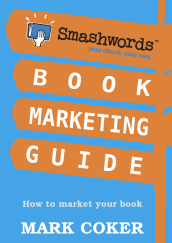
As usual, I was wandering around the internet looking for interesting things when I came upon this free eBook on Smashwords.com. It’s called Smashwords Book Marketing Guide, by Mark Coker, and it’s very informative. Basically, he goes over 33 tips on how to market your eBook. I was hesitant about downloading it, because I figured it would just be promotion for Smashwords, and it was, but it also had some pretty great ideas for marketing. I’ll share two or three of the tips below, and then I encourage you to go download the eBook. It is, after all, free!

Tip #1: Update your email signature. Your email signature is one of the most powerful marketing tools at your disposal, yet few authors take advantage of it. Most of us send emails to dozens if not hundreds of people each week, and each of these people (often friends, family, business associates, fans) represent potential customers for our book. By updating (or creating) an email signature, you’re providing email recipients a low-key, unobtrusive path to discover and purchase your book. Nearly every email program and service allows you to create a single email signature file, usually a simple text file, that then automatically appends to every email you write.

Tip #18: Invite other Authors to Post to your Blog. If you operate your own blog, invite your favorite authors to write guest posts for your blog. This is a great way to offer your fans interesting new content that increases the value of your blog. It also helps fans of the other author learn more about you.

Tip #26: Create a reader’s guide at the end of your book. You’ve probably seen these in print books: Publishers append short discussion guides for reading clubs and book groups at the ends of their books. Make it fun and easy for a book group to discuss you book. While most of us like to read books in private, we enjoy talking about books with our social circles, both online and offline. If you create a reading guide, be sure to advertise it in your book description with a simple statement such as, “Contains a helpful discussion guide for reading groups.”

Tip #27: Insert sample chapters from your other books. The last page of your book is valuable real estate. Your reader just loved your book, and they want to read more from you, so give them more book samples to read at the end of your book.

He also lists a variety of top eBook listing sites that you can put your book on for maximum exposure at the end of the document. A lot of them deal with free eBooks, but some of them list normal eBooks as well.

So check out the eBook — again, here’s the link to the site where you can download it for free.

And now for something completely different:

Categories: Self Publishing | Tags: , , , , , , , , , , | 2 Comments

When Big Time Authors Self-Publish

I just found this article at Publishers Weekly that talks about how Terry Goodkind, best-selling author of the Sword of Truth series, is self-publishing his next novel. It makes me wonder what a famous, successful author like him is doing self-publishing a book. I mean, I would probably die of happiness if I were to get traditionally published, but Goodkind is walking away from it. And the more I consider the matter, the more it makes sense. Here’s my reasoning:

1. He already has a fan following. As such, he can be pretty much assured that anything he publishes in the Sword of Truth series, people will buy, myself included.

2. He has the money for marketing/publicity. Self-published authors are generally 9-5ers trying to write on the side, and don’t have the funds to launch international marketing campaigns. But Goodkind, and other big-time authors, do have the time and money to do that kind of thing. His publishing house probably could get his book into more stores, place advertisements in better locations, but as per #1, he already has a huge fan base. They’ll find out about the book regardless of how limited the marketing campaign is.

3. He’ll get higher royalties. This one is a no-brainer. When an author self-publishes, they set the price. Traditionally published authors usually get between 5-15% royalties — good if you’re in the 15% range, terrible if you’re down at 5%. If you’re self-publishing, you obviously make way more, plus you decide how much the book goes for. I guess he’ll be losing the prestige of having a traditional publishing house’s logo on the spine of his book, but he’ll probably survive.

4. He has complete creative freedom. I’ve heard horror stories of editors ripping apart books and sewing them back together in pathetic imitations of their originals. I have no idea if this is true — probably not, let’s be realistic. However, that doesn’t change the fact that self-publishing allows you to write whatever the heck you want, regardless of what anyone else (or society in general) thinks. My only problem with this is that some authors do need to be reined in by editors, Goodkind included. He has a tendency to get very preachy, and I’m worried he’ll just go crazy with the rants once there’s no one there to stop him. Of course, for all I know, he’s been deciding what goes into his books for years, and the publishing house has just been crossing their fingers and hoping things worked out.

5. He’ll get a lot of attention for self-publishing. Traditional publishing houses are worried about self-publishing, because it cuts into their profit margins, and will do so more in the future. Once a decent amount of big time authors join the self-publishing bandwagon, I don’t see things going well for publishing houses. Since self-publishing doesn’t happen that often right now, Goodkind should get media attention for his decision to self-publish based on that fact alone, regardless of how well his book actually sells.

Looking at it this way, it seems crazy that big time authors wouldn’t try out self-publishing. On the other hand, there are many excellent reasons to stay with traditional publishers. So I guess it really comes down to individual choice.

What do you think?

Imagine you’re a big time author, and you’re planning to release a new book. Would you consider self-publishing?

Image cred: http://www.fanpop.com/spots/sword-of-truth-series/images/684599/title/cover-art-faith-fallen-photo

Categories: Self Publishing | Tags: , , , , , , , , , | 7 Comments

How do you decide what to write?

I’ve recently been having a crisis. I would call it a crisis of faith, but that seems a little overly dramatic. Let’s call it a literary crisis.

I love writing, obviously. I love to write books, especially YA books. Ideally, I’d like to write about whatever I want, and then sell enough of these books that I can quit my day job and write books for a living. But the problem is that what I like to write, and what is currently popular, do not match up.

I recently read an article which outright stated, “If you want to make money, write Vampire Erotica”. And I have to say, I was tempted. I mean, vampires are in right now. If I were to write even a semi-decent book about vampire romance, I could probably make a good amount of money. But is that the sort of thing I want to do? And I’m not talking about sacrificing my integrity as an author. I mean, do I want to put myself through the process of dreaming up a story about vampires and humans and werewolves and all the other literary tropes that are selling right now? The answer is: I don’t know.

Money rocks. But so does writing what I care about. And I’m not sure I could care about vampires. I love Buffy the Vampire Slayer, and I quite enjoyed Twilight, but that was less because of the vampires and more about the characters. Everything I know about vampires is from TV and books, and most of that information contradicts itself. The original vampire looked like a demon, after all–hardly something you want your main character locking lips with. I suppose if I came up with interesting enough characters I wouldn’t mind churning out a vampire romance, but for all I know, by that point society will have moved on to the next YA craze, and I’ll be left with a vampire romance that no one will want to buy or read.

Maybe that’s the way to look at it. YA crazes come in phases, and ultimately, you should write what you want to write. Even if the book doesn’t have an audience now, it might very well in a year or two. I guess it comes down to whether you’re writing for love of writing, or for love of making money. And if I’m writing for the second reason, I might as well throw in the towel now, because the best sellers are non-fiction, and I am worse than useless at writing anything other than fantasy or sci-fi. So I’m going to keep on typing what I know and love, and hopefully I’ll be able to find an audience out there someday to appreciate my creations!

What do you think?

Is it important to consider potential sales and marketability when writing a book? Should a real writer care whether or not they make the New York Times Best-seller List?

Categories: Writing | Tags: , , , , , , | 12 Comments

Character Creation Exercise

So I play a little game called Dungeons & Dragons (heard of it?) which can be either an amazingly fun or horrifyingly dull experience based on who plays with you. One of my favourite parts of D&D is character creation, where you get to build your own character from the ground up. I think I actually started playing D&D before I started writing, which leads me to wonder if I didn’t get into writing because of D&D. Running a game in D&D is basically the same as writing a novel – you lay out the plot, the characters, the conflicts, the rewards, and then you play out the story as your fellow D&D players help you fill out all the details.

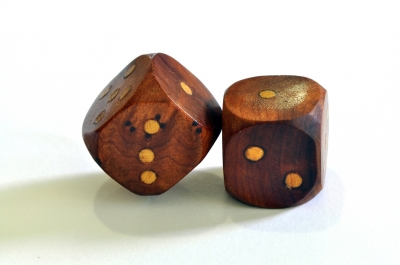
Anyway, I’m getting off topic. The point is that D&D introduced me to a method of character creation that, with a little tweaking, works great for authors trying to come up with new characters. All you need is a basic six-sided die (like the one in the picture above), a sheet of paper, a pencil, and the instructions I’m about to give you.

This basically works like a quiz, except you use the dice to choose your answer randomly. So, each question has a series of answers from 1-6. If you roll a 1, then your answer is #1. If you roll a 3, your answer is #3, etc. Record your answers on the paper so you don’t forget what you rolled. You can come up with some very interesting characters this way, because you never know what combinations you’ll end up with, and then you have to work out a back story that explains how the character ended up the way they did. Even if you don’t use this character in a story, it’s still fun to do the exercise and just see what ridiculous characters you can come up with.

Ready? Okay, go!

Where is my character from?

  1. Medium-sized city
  2. Cozy hamlet
  3. Isolated village
  4. Wilderness
  5. Sprawling metropolis
  6. Exotic locale

What is my character’s family like?

  1. Large family
  2. Only child
  3. Orphan
  4. One parent living, one dead
  5. Nuclear family
  6. Adopted family

What is my character’s favourite activity?

  1. Reading
  2. Sports
  3. Fighting
  4. Networking
  5. Intellectual pursuits (math, science, etc.)
  6. Breaking the rules

What is my character’s goal in life?

  1. Wealth
  2. Fame
  3. Love
  4. Relaxation
  5. Accomplish something great
  6. No goal

How is my character’s love life?

  1. Married
  2. Divorced
  3. Recently broken-up
  4. Unrequited love
  5. Single
  6. Complicated

What is my character’s spiritual belief?

  1. Monotheistic
  2. Polytheistic
  3. Atheistic
  4. Agnostic
  5. Spiritual, but no organized religion
  6. Formerly religious, but lost the faith

What is my character’s personality?

  1. Optimistic
  2. Curious
  3. Easily angered
  4. Compassionate
  5. Apathetic
  6. Nervous

What is my character’s worst memory?

  1. Death of a loved one
  2. Mugged/attacked
  3. Betrayed
  4. Loss of honour/social standing
  5. Natural disaster
  6. Abandoned

How does my character react in a crisis?

  1. Panics
  2. Keeps a level head
  3. Looks to others for direction
  4. Is only concerned with himself/herself
  5. Freezes
  6. Takes the lead

What is my character’s most prized possession?

  1. Book
  2. Vehicle
  3. Animal
  4. Weapon
  5. Trinket of sentimental value (e.g. locket, comb, etc.)
  6. Money

You’re done! Congratulations!

You have officially created a character. Now you need to figure out why they are the way they are. For example, I will go back and do the exercise, and share with you my findings. Hang on, let me find a die …

Okay, so my dice rolls are: 4, 1, 2, 1, 2, 4, 5, 3, 6, and 2. What does that mean for my character? For ease, we’ll say it’s a she.

She was born in the wilderness. She comes from a large family. She enjoys playing sports. Her goal is the acquisition of wealth. She’s divorced. She’s agnostic and apathetic. Her worst memory is being betrayed. She takes the lead in a crisis, and her most prized possession is a vehicle.

Now I take my answers and connect the dots. She was born in a remote location to a large family, so she comes from a large clan of traditionally-minded, down-to-earth country folk. She’s very athletic, because she loves sports. Her favourite sport is mountain biking, and she loves her bike above all else. She was married, but her husband betrayed her, and she’s apathetic to life in general because of it. However, she’s also very strong-willed, and wants to get ahead in life by accruing a large sum of money. From here, I extrapolate. Why does she want money? Perhaps her loving, down-to-earth family is in some sort of financial crisis, and she needs to help them before the whole family goes under. Or, maybe she is a professional mountain biker, and wants to win a competition and therefore the championship purse. Because of her apathy, she’s probably feeling very lost after her husband’s betrayal, and therefore has trouble connecting with people or opening herself up to the idea of dating again.

I’ll probably throw away this character. She doesn’t strike me as the kind of character I would spend time writing a proper story about. But you get the point!

Now go forth, create a character, and let me know in the Comments how it goes 🙂

Humorous meme of the day:

Categories: Writing | Tags: , , , , , , , , , , , | 8 Comments

Evil Overlord’s List

So I was wandering about the internet this morning, and came across this site, which I haven’t visited in years but still fondly remember as one of the funniest things I have ever read. It is a list, entitled The Top 100 Things I’d Do If I Ever Became An Evil Overlord, and it’s hysterical. Here are some of my favourites:

8. After I kidnap the beautiful princess, we will be married immediately in a quiet civil ceremony, not a lavish spectacle in three weeks’ time during which the final phase of my plan will be carried out.

12. One of my advisors will be an average five-year-old child. Any flaws in my plan that he is able to spot will be corrected before implementation.

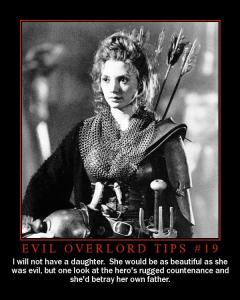
19. I will not have a daughter. She would be as beautiful as she was evil, but one look at the hero’s rugged countenance and she’d betray her own father.

23. I will keep a special cache of low-tech weapons and train my troops in their use. That way — even if the heroes manage to neutralize my power generator and/or render the standard-issue energy weapons useless — my troops will not be overrun by a handful of savages armed with spears and rocks.

34. I will not turn into a snake. It never helps.

44. I will only employ bounty hunters who work for money. Those who work for the pleasure of the hunt tend to do dumb things like even the odds to give the other guy a sporting chance.

47. If I learn that a callow youth has begun a quest to destroy me, I will slay him while he is still a callow youth instead of waiting for him to mature.

56. My Legions of Terror will be trained in basic marksmanship. Any who cannot learn to hit a man-sized target at 10 meters will be used for target practice.

64. I will see a competent psychiatrist and get cured of all extremely unusual phobias and bizarre compulsive habits which could prove to be a disadvantage.

80. If my weakest troops fail to eliminate a hero, I will send out my best troops instead of wasting time with progressively stronger ones as he gets closer and closer to my fortress.

85. I will not use any plan in which the final step is horribly complicated, e.g. “Align the 12 Stones of Power on the sacred altar then activate the medallion at the moment of total eclipse.” Instead it will be more along the lines of “Push the button.”

98. If an attractive young couple enters my realm, I will carefully monitor their activities. If I find they are happy and affectionate, I will ignore them. However if circumstance have forced them together against their will and they spend all their time bickering and criticizing each other except during the intermittent occasions when they are saving each others’ lives at which point there are hints of sexual tension, I will immediately order their execution.

There are also more hilarious list items in Cell Block A and Cell Block B. Check it out!

Image credit: http://seemslegit.com/post/view/3627?search=evil

Categories: Random | Tags: , , , , , , , | 4 Comments

10 Things I’ve Learned About Editing

  1. Spell check is not optional. You can read over your manuscript three dozen times, and you still won’t catch all the typos. Guaranteed.
  2. Dialogue rocks. So does describing the setting. If you forget where your characters are, don’t go back and check to remind yourself. Add more setting description. If you forget, so will your readers.
  3. Commas are useful, but often not necessary. If you have more than three commas in a sentence that does not include a list, they’re not necessary.
  4. Sci-fi and fantasy allow you to break the laws of physics. But when you break the laws, everything still has to make sense and be consistent. If it doesn’t, you’re compromising the integrity of your world.
  5. Don’t capitalize unless you absolutely have to. The most annoying thing in the world is to read a sentence like this: “Then Antiloch, Son of the Desert Guru, rode forth on his mighty Andalarian Prancer to aide the Chandoran Sages in their Abolition of the Tyrant King Zandif of Kardovak.”
  6. Tightening your phrasing is good. Cutting out a great sentence for the sake of tightening your manuscript is not. Be careful with what you cut and what you keep.
  7. You’re the writer, no matter what your editor thinks. If you like something, then keep it in the manuscript. But figure out why your editor wants you to cut it first, just in case they’re right.
  8. When you read something and think, “This sounds a bit weird, but I don’t really want to change it”, change it. It will sound weird to your reader too, and they will enjoy the book less because of it.
  9. If your editor asks you why a character does something and you don’t know, figure it out.
  10. Editing is work, but it also has to be fun. If you want to bash your head against the desk, stop editing! Unless you have a deadline. Then you should probably keep going.
Categories: Writing | Tags: , , , , , , | 4 Comments

Blog at WordPress.com.