Writing

Posts about writing.

Short Story Contests 2012

I found this amazing article that lists about a gazillion upcoming short story contests. If you have ever or ever intend to write a short story, you should check out the link, because there are a heckuva lot of lucrative contests upcoming!

NOTE: As always the case when giving away your intellectual property and your money, double check and make sure the contest is legitimate before entering.

Awesome of the day:

FYI, the entire video was done in one take, so the performers basically ran around the house setting themselves up for their next appearance on camera. There was a girl whose sole job was to toss instruments to the performers. There’s a link at the end of the video to the Behind the Scenes video, if you’re interested.

Image cred: http://www1.cse.wustl.edu/~faanly/miscellaneous.htm

Categories: Writing | Tags: , , , , , , , , , | 3 Comments

Amateur Writing Tips: POV (Point of View)

Plots and characters are undoubtedly important things to consider when writing a novel. I would argue, however, that POV is even more crucial. This is because if you screw up the POV, no one will even think about reading your book, regardless of how great the plot or characters are.

I’ll prove my point. Read the following paragraph:

You walk toward me, hips swaying as your silky black stilettos clack on the marble tiles. Bradley sits casually at the bar, considering what to say to the beautiful woman approaching him. She’s way too good for him, thinks the bartender. I eat up the luscious man lounging at the bar with my eyes. “What can I get you?” asks the bartender.

Has your brain exploded yet? That’s because of all the shifting POVs. For the record, the POVs in that paragraph went as follows: second-person → third-person → first-person → third-person. Ack, I say. Ack.

But there is a solution! I like to call it the “Know your POVs so you don’t explode your reader’s brain” solution. It’s my understanding that brain-explosion is frowned upon, so you might want to avoid doing that if at all possible.

Without any further ado …

Michelle’s Guide to POV

First Person

For first-person narration, you essentially write the story from the perspective of one of your characters. One of the best examples of this POV is in the Hunger Games series by Suzanne Collins. The story is told from Katniss’ POV, meaning we only get her perspective. If something happens that she doesn’t know about, we don’t know about it either. First-person limits you to what a single character is experiencing, but it also allows you to delve deep into the mind of your protagonist, which can be a very powerful addition to your story.

Example:

I don’t know why, but there’s something about him that enthrals me. Maybe it’s his smooth skin and his tousled ebony hair. Maybe it’s the way he says my name, like smooth bourbon sliding over my lips. Maybe it’s because he’s a vampire who has literally enthralled me with his sinister vampiric powers. Whatever the reason, I know that I must have him. Right now. On the dirty concrete floor if necessary. Although a bed would be preferable. Pillows are probably more comfortable than concrete.

Second Person

Second-person narration is where you write like you’re talking to the reader–sort of like what I’m doing right now. You find second-person a lot in those Choose Your Own Adventure books, although Wikipedia claims that there are multiple famous authors who have used this POV. Clearly I need to read more, because I’ve only heard of one of those people. Anyway, second-person isn’t used very much in books, so you probably shouldn’t use it either. Unless you want to. In which case, go nuts. Just don’t expect me to read it.

Example:

You watch the wave flow gently up the beach. The cool water laps at your toes, making you shriek with delight and jump back. Then the wave retreats, and you scurry forward again, wondering how far you can get down the wet sand before the water returns to claim you. But you misjudged, and the wave rushes toward you, covering you up to your thighs. Your pants dissolve, and you are suddenly standing on the beach wearing nothing but your underwear. You probably shouldn’t have worn cotton candy pants to the beach, no matter how trendy the salesperson said they were.

Third Person

Third-person is the most common POV style. It’s told from an outside perspective, and all the characters are referred to by their name, or by “he”, “she”, or “it”. JK Rowling’s Harry Potter series is written in third person, as is the Game of Thrones series by George RR Martin.

The two big types of third-person POV are third-person limited and third-person omniscient. Third-person limited is from the perspective of one character; the third-person omniscient narrator knows all and sees all.

Example:

Harmony bowed to the crowd, who applauded madly. Then she began the dance. First she twirled, then she flipped, then she did an acrobatic spin that nearly spun her right off the stage. The roaring of the crowd grew louder. Encouraged by their support, Harmony gathered her nerves for the final act. Balancing on her tail, Harmony built up the fire in her lungs and then let it shoot forth from her mouth in a multi-coloured inferno of flame and heat. But she overshot the target dummy. The flames splashed onto the flammable tent walls, igniting the fabric and inciting mass panic in the crowd. “Please, don’t panic!” Harmony pleaded, trying desperately to put the flames out. “I’ll fix it! Don’t leave!” But no one understood her, because Harmony was a dragon, and dragons can’t speak English.

There are pros and cons to each of these. I personally prefer third-person limited, because restricting the POV to one character leaves you room to do big reveals–e.g. that Harmony is a dragon. However, third-person omniscient lets you get into all the character’s heads, which can be great–except that if you reveal what everyone is thinking, it kind of takes away some of the mystery.

First-person is more like writing a diary, in that everything–descriptions of places, characters, interpretations of events–is from that character’s POV. I’m actually writing a book right now in first-person, the first time I’ve attempted this POV, and it’s going pretty well. I like being able to get into my character’s head and see the world through her eyes, but it also prevents me from showing the reader what the other characters are going through, which can be restrictive at times.

But as always with writing, the choice is ultimately up to you.

What do you think?

What’s the best POV? What POV are you writing in right now? Are there certain POVs that work better with different styles of writing? Is there any POV you hate?

Image cred: http://siennanorth.blogspot.ca/2012/05/point-of-view-demystified.html

Categories: Writing | Tags: , , , , , , , | 57 Comments

Merry Grammarmas to all and to all a goodnight!

Just ran across this awesome blog post on Blah Blah Blog. Enjoy!

Merry Grammarmas to all and to all a goodnight!.

Categories: Writing | Tags: , , | Leave a comment

8 Things I Learned from my Proofreaders

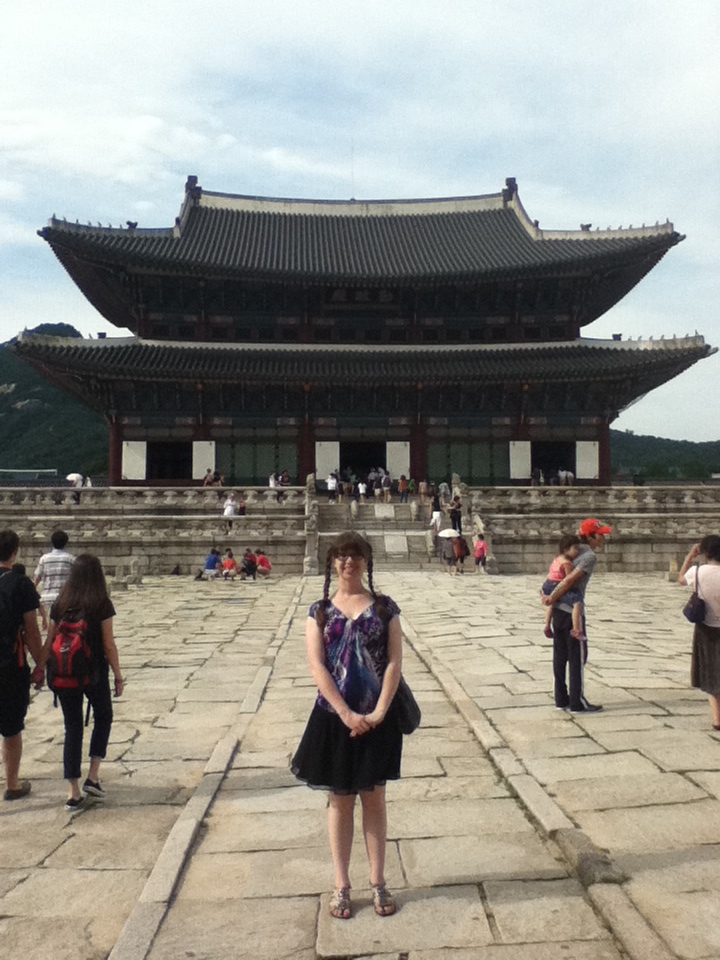
Me at the Gyeongbokgung Palace in Seoul, South Korea. Note my whimsical attire.

I don’t know if you remember, but a few weeks back I wrote a post about my super awesome book editing kick-off party. Three weeks later (also known as yesterday), we had the book editing wrap-up party. Merriment was had, alcohol was consumed, and many suggestions were made about how to make my book the best it can possibly be. A lot of them were very specific to my book, but I thought I’d share some of the more general wisdom here with you.

1. For a traumatic event to be believable, the character’s reaction has to fit the situation. Obviously ever character will react differently to a traumatic event, but never underestimate the impact of a good emotional breakdown. Or several.

2. Use the 5 stages of grief. To remind you, those stages are: denial, anger, bargaining, depression, and acceptance. The 5 stages of grief are used in everything from high-brow literary fiction to bad TV sitcoms, and there’s a very good reason for that.

3. Blue-raspberry jello tastes delicious with cinnamon sprinkled on top.

4. Check your facts. Otherwise you run into the embarrassing situation of a reader telling you that something you wrote was totally, unbelievably wrong.

5. Your characters can’t take everything for granted. Having your character encounter an enigmatic person or a ridiculous situation and grow accustomed to the oddity is fine, but make sure they are appropriately incredulous at first. Even if it’s something as simple as them asking, “Wait, why are you helping me?”. They don’t even need to receive a response – it’s just human instinct to question what we don’t know or understand. Unless you’re writing about something non-human, in which case you can do whatever the heck you like.

6. Be careful when you write about religion. People get really worked up over religion, and you don’t want to mess with that unless you have a very good reason for doing so.

7.  Too much or too little description of the love interest is bad. You want to give just enough description to let the reader form a picture in their mind of the character, but not enough that there’s no room for them to let their imagination run free. That’s a problem that book-to-movie adaptations run into all the time. A character is way over-described in a book, like: “6 foot 3, short blonde hair, emerald green eyes, straight nosed, full lips, broad forehead, square jaw, muscular, faint scar on the shoulder blade, etc.”, and then fans get all riled up when a hipster brunette is cast in the role.

8. Don’t let conflicting opinions weigh you down. People disagree all the time, and I guarantee that they will find things to disagree about when reading your book. The best advice I can give is to listen carefully to all sides of the argument, then make an informed decision on how to proceed based on your own opinions. This might annoy the people you’re disagreeing with, but ultimately it’s your book, and you get veto power.

Once I get all my proofread copies of the manuscript back, I’ll sit down for the FINAL EDITING ROUND, because I’ve been working on this book for six years now and it’s quite about time that I get it published and move on with my literary life. If anyone has any editing advice for me before I start the FINAL EDITING ROUND, or wants to weigh in on the post, or on my whimsical outfit, I’d love to hear from you!

Around the Interwebs:

Categories: Writing | Tags: , , , , , , , | 10 Comments

Ten Rules for Writing Fiction

In my eternal attempt to avoid doing work, I was once again meandering about the internet, looking for entertainment. I came across this article: Ten Rules for Writing Fiction.

What’s very cool about this article is that it doesn’t just give ten rules. It gives you ten rules from each of about a bajillion different authors from various genres and backgrounds. This means that some of the rules contradict each other, which I found very interesting. It goes to show that what works well for one author will have absolutely no relevance to another author. Writing is truly about personal taste, which is part of what makes writing such a daunting task — there is no “How To” guide that speaks individually to each author. You have to make up your own, and then tweak and refine your list until you figure out what works for you.

I’m not a famous author, but I thought I’d share my own Ten Rules for Writing Fiction with you. Partial credit for the list goes to Linda Schneidereit, my mother, muse, and mentor. Without further ado, here they are!

Michelle’s Ten Rules for Writing Fiction

1. Write to your audience. This means putting yourself in the reader’s shoes, imagining how they will react when they read your story, and using themes and language that are appropriate for that age and gender range. Don’t even think about publishing until you’ve gotten a real live member of your intended audience to proof read the book. They are a better judge of what they like than you are, so listen to them.

2. Write what you’re passionate about. This applies doubly to projects that require research. Some people can spend hours upon hours researching every detail of the historical era they’re trying to recreate. Others can’t. If you can’t, then don’t force yourself. Write something you know more about, something that won’t make you want to beat your head against a wall until you crack open your skull. Which leads into the next rule …

3. Whatever you do, don’t think of writing as “work”. If you do that, you’re sunk. Imagine getting home from your 8-10 hour work day, then sitting down at your computer and working three or four hours more. That’s not fun, and that won’t produce good writing. Stop writing, take a break, come back later. Writing is supposed to be enjoyable.

4. Don’t become too attached to any one part of your story. You’re going to have to change a majority of what you write, be it phrasing, character development, or even the entire plot. Loving your creation is a good thing, but smothering it with unwarranted affection is not. Be brutal with your edits. It will make your story better, and make you a better writer.

5. Get someone else to edit your writing. Preferably this will be someone with a literary background, who reads a lot, or even just someone who is fairly intelligent. Spell check won’t catch logical flaws or plot inconsistencies in your story any more than you will. Know why? Because you wrote it, and it makes sense to you — you wouldn’t have written it otherwise. It takes an outside opinion to point out the problems, and I guarantee you, there will be problems.

6. Make sure your characters speak uniquely. Each character should have their own voice. This could be something as simple as having an accent (Hagrid, anyone?), or something more complex, like using overly flamboyant language, or saying “like” a lot, or using poor grammar. Choose a passage of dialogue and take out the “he said” and “she said”s. If you can’t figure out who is saying what, you need to rethink their speech patterns.

7. Don’t bog things down with description. A paragraph explaining where the characters are is fine. Three pages of description is too much. How many people have read Lord of the Rings and skipped over page after page of descriptions of trees, rivers, and assorted scenery? Your reader needs to know where they are in the world you’ve created. That’s it.

8. Close your internet browser. It will distract you. Even YouTube can be harmful, especially if you’re not using a playlist. Open it if you need to research a fact or Google a name, then close it immediately.

9. Listen to music. Pay special attention to the lyrics. Musicians are story-tellers through song. Imagine the characters in your novel singing the words, then figure out why they are saying these things. Music evokes emotions in people in a way that few other things can, and it can serve as an excellent muse when you don’t know what to write next.

10. Don’t let other people bring you down. Sharing a great new story idea with someone, and having them flat-out tell you they think it’s terrible, or that they don’t like it at all, can be extremely disheartening. Remember that you’re the writer, not them, and that you can write whatever you damn well please. Even if they don’t like what you’ve written, or something you intend to write, there are over six billion people in the world. Odds are, you’ll be able to find an audience somewhere out there who’ll love your creation just as much as you do. So grab that keyboard, or pick up that pen, and get writing!

I’m sure I have many more rules floating around in my head, but these are the ones that come to mind. I’d love to hear your own list of writing rules, so please feel free to leave them in the Comments section, or provide a link back to your own blog. And check out the article link, because there are a lot of really great tips buried amongst the hundreds of writing rules.

Awesome pic of the day:

Categories: Writing | Tags: , , , , , , , | 12 Comments

How do you decide what to write?

I’ve recently been having a crisis. I would call it a crisis of faith, but that seems a little overly dramatic. Let’s call it a literary crisis.

I love writing, obviously. I love to write books, especially YA books. Ideally, I’d like to write about whatever I want, and then sell enough of these books that I can quit my day job and write books for a living. But the problem is that what I like to write, and what is currently popular, do not match up.

I recently read an article which outright stated, “If you want to make money, write Vampire Erotica”. And I have to say, I was tempted. I mean, vampires are in right now. If I were to write even a semi-decent book about vampire romance, I could probably make a good amount of money. But is that the sort of thing I want to do? And I’m not talking about sacrificing my integrity as an author. I mean, do I want to put myself through the process of dreaming up a story about vampires and humans and werewolves and all the other literary tropes that are selling right now? The answer is: I don’t know.

Money rocks. But so does writing what I care about. And I’m not sure I could care about vampires. I love Buffy the Vampire Slayer, and I quite enjoyed Twilight, but that was less because of the vampires and more about the characters. Everything I know about vampires is from TV and books, and most of that information contradicts itself. The original vampire looked like a demon, after all–hardly something you want your main character locking lips with. I suppose if I came up with interesting enough characters I wouldn’t mind churning out a vampire romance, but for all I know, by that point society will have moved on to the next YA craze, and I’ll be left with a vampire romance that no one will want to buy or read.

Maybe that’s the way to look at it. YA crazes come in phases, and ultimately, you should write what you want to write. Even if the book doesn’t have an audience now, it might very well in a year or two. I guess it comes down to whether you’re writing for love of writing, or for love of making money. And if I’m writing for the second reason, I might as well throw in the towel now, because the best sellers are non-fiction, and I am worse than useless at writing anything other than fantasy or sci-fi. So I’m going to keep on typing what I know and love, and hopefully I’ll be able to find an audience out there someday to appreciate my creations!

What do you think?

Is it important to consider potential sales and marketability when writing a book? Should a real writer care whether or not they make the New York Times Best-seller List?

Categories: Writing | Tags: , , , , , , | 12 Comments

What music do you listen to when you write?

Sometimes when I’m trying to write a particularly emotional scene (sad, happy, romantic, exciting, etc.), I have trouble putting myself in that particular emotional mindset. One of the best ways I’ve found to counter this type of writer’s block is by listening to a song (usually put on endless repeat) that embodies the particular emotion I’m trying to convey.

I’m going to share some of my current favourite emotion-inducing songs with you here, so grab some headphones and enjoy!

Happy

“I Am (Record Version” is from the anime Inuyasha. It’s light, cheery, has lots of xylophone and flute, and just makes me smile every time I hear it.

Angry

“Let’s Start a Riot” is loud, raucous, and makes me want to riot every time I hear it. Warning: don’t talk to anyone for at least a few minutes after listening to this song. You will feel very pumped up and confrontational, so cool down a bit first.

Romantic

“First Love” is a Japanese song reminiscing about a girl’s first love. I actually prefer listening to songs in different languages when I’m writing, because lyrics often distract me from what I’m writing. If the lyrics are in a different language, however, it’s much harder to get distracted by them!

Melancholy

“Safe and Sound” is from the Hunger Games soundtrack. Every time I listen to this, I picture a girl sitting alone in an empty room, nostalgically remembering a simpler, happier time.

What about you?

What songs do you listen to when you write? I’m always looking for new music, so please share!!!

Categories: Writing | Tags: , , , , , , , , , | 11 Comments

Character Creation Exercise

So I play a little game called Dungeons & Dragons (heard of it?) which can be either an amazingly fun or horrifyingly dull experience based on who plays with you. One of my favourite parts of D&D is character creation, where you get to build your own character from the ground up. I think I actually started playing D&D before I started writing, which leads me to wonder if I didn’t get into writing because of D&D. Running a game in D&D is basically the same as writing a novel – you lay out the plot, the characters, the conflicts, the rewards, and then you play out the story as your fellow D&D players help you fill out all the details.

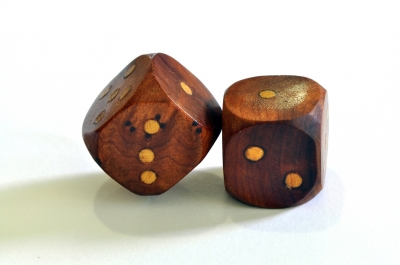
Anyway, I’m getting off topic. The point is that D&D introduced me to a method of character creation that, with a little tweaking, works great for authors trying to come up with new characters. All you need is a basic six-sided die (like the one in the picture above), a sheet of paper, a pencil, and the instructions I’m about to give you.

This basically works like a quiz, except you use the dice to choose your answer randomly. So, each question has a series of answers from 1-6. If you roll a 1, then your answer is #1. If you roll a 3, your answer is #3, etc. Record your answers on the paper so you don’t forget what you rolled. You can come up with some very interesting characters this way, because you never know what combinations you’ll end up with, and then you have to work out a back story that explains how the character ended up the way they did. Even if you don’t use this character in a story, it’s still fun to do the exercise and just see what ridiculous characters you can come up with.

Ready? Okay, go!

Where is my character from?

  1. Medium-sized city
  2. Cozy hamlet
  3. Isolated village
  4. Wilderness
  5. Sprawling metropolis
  6. Exotic locale

What is my character’s family like?

  1. Large family
  2. Only child
  3. Orphan
  4. One parent living, one dead
  5. Nuclear family
  6. Adopted family

What is my character’s favourite activity?

  1. Reading
  2. Sports
  3. Fighting
  4. Networking
  5. Intellectual pursuits (math, science, etc.)
  6. Breaking the rules

What is my character’s goal in life?

  1. Wealth
  2. Fame
  3. Love
  4. Relaxation
  5. Accomplish something great
  6. No goal

How is my character’s love life?

  1. Married
  2. Divorced
  3. Recently broken-up
  4. Unrequited love
  5. Single
  6. Complicated

What is my character’s spiritual belief?

  1. Monotheistic
  2. Polytheistic
  3. Atheistic
  4. Agnostic
  5. Spiritual, but no organized religion
  6. Formerly religious, but lost the faith

What is my character’s personality?

  1. Optimistic
  2. Curious
  3. Easily angered
  4. Compassionate
  5. Apathetic
  6. Nervous

What is my character’s worst memory?

  1. Death of a loved one
  2. Mugged/attacked
  3. Betrayed
  4. Loss of honour/social standing
  5. Natural disaster
  6. Abandoned

How does my character react in a crisis?

  1. Panics
  2. Keeps a level head
  3. Looks to others for direction
  4. Is only concerned with himself/herself
  5. Freezes
  6. Takes the lead

What is my character’s most prized possession?

  1. Book
  2. Vehicle
  3. Animal
  4. Weapon
  5. Trinket of sentimental value (e.g. locket, comb, etc.)
  6. Money

You’re done! Congratulations!

You have officially created a character. Now you need to figure out why they are the way they are. For example, I will go back and do the exercise, and share with you my findings. Hang on, let me find a die …

Okay, so my dice rolls are: 4, 1, 2, 1, 2, 4, 5, 3, 6, and 2. What does that mean for my character? For ease, we’ll say it’s a she.

She was born in the wilderness. She comes from a large family. She enjoys playing sports. Her goal is the acquisition of wealth. She’s divorced. She’s agnostic and apathetic. Her worst memory is being betrayed. She takes the lead in a crisis, and her most prized possession is a vehicle.

Now I take my answers and connect the dots. She was born in a remote location to a large family, so she comes from a large clan of traditionally-minded, down-to-earth country folk. She’s very athletic, because she loves sports. Her favourite sport is mountain biking, and she loves her bike above all else. She was married, but her husband betrayed her, and she’s apathetic to life in general because of it. However, she’s also very strong-willed, and wants to get ahead in life by accruing a large sum of money. From here, I extrapolate. Why does she want money? Perhaps her loving, down-to-earth family is in some sort of financial crisis, and she needs to help them before the whole family goes under. Or, maybe she is a professional mountain biker, and wants to win a competition and therefore the championship purse. Because of her apathy, she’s probably feeling very lost after her husband’s betrayal, and therefore has trouble connecting with people or opening herself up to the idea of dating again.

I’ll probably throw away this character. She doesn’t strike me as the kind of character I would spend time writing a proper story about. But you get the point!

Now go forth, create a character, and let me know in the Comments how it goes 🙂

Humorous meme of the day:

Categories: Writing | Tags: , , , , , , , , , , , | 8 Comments

10 Things I’ve Learned About Editing

  1. Spell check is not optional. You can read over your manuscript three dozen times, and you still won’t catch all the typos. Guaranteed.
  2. Dialogue rocks. So does describing the setting. If you forget where your characters are, don’t go back and check to remind yourself. Add more setting description. If you forget, so will your readers.
  3. Commas are useful, but often not necessary. If you have more than three commas in a sentence that does not include a list, they’re not necessary.
  4. Sci-fi and fantasy allow you to break the laws of physics. But when you break the laws, everything still has to make sense and be consistent. If it doesn’t, you’re compromising the integrity of your world.
  5. Don’t capitalize unless you absolutely have to. The most annoying thing in the world is to read a sentence like this: “Then Antiloch, Son of the Desert Guru, rode forth on his mighty Andalarian Prancer to aide the Chandoran Sages in their Abolition of the Tyrant King Zandif of Kardovak.”
  6. Tightening your phrasing is good. Cutting out a great sentence for the sake of tightening your manuscript is not. Be careful with what you cut and what you keep.
  7. You’re the writer, no matter what your editor thinks. If you like something, then keep it in the manuscript. But figure out why your editor wants you to cut it first, just in case they’re right.
  8. When you read something and think, “This sounds a bit weird, but I don’t really want to change it”, change it. It will sound weird to your reader too, and they will enjoy the book less because of it.
  9. If your editor asks you why a character does something and you don’t know, figure it out.
  10. Editing is work, but it also has to be fun. If you want to bash your head against the desk, stop editing! Unless you have a deadline. Then you should probably keep going.
Categories: Writing | Tags: , , , , , , | 4 Comments

Face Punch — A Twilight Parody

I joined a short story club a few years back, and one week I cranked out this baby. It’s a parody of Stephanie Meyers’ Twilight series, and it … well, it’s strange. Don’t get me wrong, I actually really enjoyed the Twilight series. I just had a few issues with Bella being a constant pushover, and vented my feelings in short story format. It’s approximately 2500 words, so make sure you have enough time before you sit down and read. And yes, the simplistic writing style is on purpose.

So without further ado, I present to you: Face Punch, a Twilight Parody

Bianca dreaded going to school that morning. She had just moved from the warm, impersonal, populous city of Los Angeles to a small town called Crossroads in the middle of the Rocky Mountains. It was cold, scarily personal, and had at the most six hundred inhabitants.

She had come to live with her aunt, as her parents had died in a car crash. Bianca was rather upset with them for inconveniencing her in such a manner, especially when she was already halfway through her junior year and well established at her old school. But she supposed that it couldn’t be helped, and so she had said goodbye to her drug-addled friends and gone to live in Nowheresville, USA.

When she arrived at school, the first thing she noticed was that all the boys in the parking lot were staring at her, and all the girls in the parking lot were glaring at her. This surprised and bewildered Bianca, for despite the fact that she was stunningly attractive and was therefore lusted after by every boy she had ever met, she was astonishingly unobservant, and therefore had always thought herself quite drab.

“Excuse me,” Bianca said to one of the gawking gentlemen. “Could you please tell me how to find room 207?”

The freckled, blonde boy favoured her with a toothy grin and wrapped his arm around her shoulders. “But of course! This way, new girl. Hey, what’s your name?”

“Bianca,” said Bianca.

“That’s a pretty name. To match a pretty girl, I’d say! I’m Matt,” added Matt. “So, you’re new here, huh?”

“How observant of you,” said Bianca. As they walked, Matt introduced her to all his friends, who fawned over her and demanded to know every intimate detail of her life, hobbies, and past flings. “I’ve never had a boyfriend,” Bianca admitted.

“But why?” her new friends cried. “You’re so mysterious and pale, despite your previous home of sunny L.A.!”

“I suppose boys just don’t go for girls like me,” said Bianca. She had the feeling that no boys here would like her either, for she had deep self-deprecation issues. Somehow she failed to notice that every boy in earshot was hanging off her every word, and imagining how they could contrive to get her into bed.

When they arrived in math class, her new friends hurried to their seats. Bianca was glad for their departure. Although they seemed to be perfectly nice, smart, friendly people, she was anti-social and had a superiority complex. Not that she would ever admit such a thing to herself.

“Ah, I see we have a new girl!”

Bianca, who was still standing uncomfortably by the front of the room, turned to see that the teacher had arrived. He was fairly nondescript; eye-coloured eyes, hair-coloured hair, and a largish nose. “You must be Bianca Fowl,” he said happily. Even though he was male, he did not immediately begin lusting after her because Bianca was underage, and pedophilia is illegal.

“Please, call me Bia,” she said, needlessly shortening her name so that her new pseudo-friends would have a cute nickname to call her by.

“I’m Mr. Blah,” said Mr. Blah, gazing around the classroom. “I see we only have one seat available. Why don’t you go sit next to Gottfried Worcestershire?”

He pointed towards the aforementioned teen, but Bianca needed no directions. When she turned to catch a glimpse of her new seatmate, she was immediately blown away by his overwhelming good looks and masterful presence. Gottfried stared out the window, brown hair falling handsomely into his eyes, hands clenching and unclenching for some unknown reason. As Bianca approached him and the empty desk, Gottfried’s chiselled jaw tightened and he turned to glare at her with such fury that she faltered in shock.

Why is he glaring at me? she thought, carefully sitting down beside him. He looks like he wants to kill me… or possibly drag me out into the forest, have his maleficent way with me, then rip out my intestines and throw me off a precipice. Goodness, I certainly hope that doesn’t happen.

Then Gottfried turned toward her, and Bianca stared into his eyes for the first time. They were like a sparkly, captivating rainbow. Her heart began to beat faster, and Bianca knew in that instant that, even though she had never spoken to this boy, and even though he to all intents and purposes appeared to hate her guts, she had fallen instantly and irrevocably in love with him.

Through the whole class, Bianca stared at Gottfried, knowing that he was dangerous, but also knowing that she would rather die than ever leave his side again. But when the bell rang, Gottfried got to his feet, leaped over the desk, and dashed out of the classroom without so much as a backwards look.

“Geez,” Matt said charmingly, coming over to help Bianca put her books away. “What’s up with Worcestershire?”

“I don’t know,” Bianca said. But she did know that she had to find out more about the elusive Gottfried. “Listen, Matt, I have to go.”

Matt looked upset, but still managed a smile. “Hey, Bia, how about we go out this Friday? I’ll get you flowers and everything.”

“I’m sorry, Matt, but I can’t,” said Bianca.

“Why not?”

“Because I am only attracted to men who glower, ignore me, and are so emotionally distant and dangerous that they nearly get me killed on a regular basis.” Bianca tried to look like she cared about Matt’s feelings as she patted him on the shoulder. “Try joining a gang. That might just be crazy enough for me to like you.”

“See if I don’t,” Matt said. He immediately began practicing his gangster speak. It was a little rough, but had potential.

Bianca decided to go find Gottfried. She hurried to the parking lot, where she spotted Gottfried walking away from the school toward the forest. Bianca hurried after him and caught him up just deep enough into the trees that no one would hear her scream if, by some unbelievably unlikely coincidence, he turned out to be a vampire.

“You have to stop following me,” Gottfried said roughly, turning to face her. Bianca tried to concentrate on his words, but she was too busy imagining kissing him. “Bia, when I’m around you… I feel like I can’t control myself.”

“Let’s be friends,” suggested Bianca.

Gottfried scowled at her. “I’m dangerous. Also, I just told you that I can’t control myself around you.”

“So you don’t want to be friends?”

“I want so much more than that. But we can only be friends.”

“Great! Then we’ll be friends.”

Gottfried turned away. “No, Bia, I can’t. It’s too dangerous.”

“But you just said—”

“I’m a vampire, alright?” he snarled. Gottfried turned and leapt into the sunlight. “Look at me! How could you ever be with a monster like me? RAHHHHHH!”

Bianca watched as he tore his shirt off. He had very nicely developed pectorals and biceps. Then the sunlight struck his skin, but instead of burning into a crisp as vampires are want to do, he began to glow like phosphorescent cave fungus. “You’re so beautiful,” said Bianca.

“And so the tiger fell in love with the koala,” murmured Gottfried.

“What?”

“We can’t just be friends,” said Gottfried. “I love you, Bia.”

“Then let’s be more than friends,” said Bianca. “Also, why didn’t you burn up in the sun?”

“Because I don’t make any sense. Now come with me. Our everlasting love deserves a celebration. It’s time to meet my family.”

“But I just met you,” protested Bianca, although it was only a mild protest, as she was hopelessly in love with the devastatingly attractive teenage vampire, and therefore would do anything to please him.

Gottfried grabbed her and, with his super vampire speed, ran them through the forest to his surprisingly modern house. “Where is the moat?” Bianca said cutely. Gottfried chuckled and showed her to the front door, taking vast amusement in her insipid statement because he, like every other boy she had ever met, was completely dazzled by her. And despite his being much older than her, he was allowed to date her, because the laws of the United States of America didn’t apply to him due to his extreme handsomeness.

They walked into the house, only to find the lavishly decorated living room filled with balloons and various other party accoutrements. Gottfried’s family – all witty, charming, and devastatingly attractive like him – smiled and welcomed her into their family. Bianca was touched, and did not feel at all uncomfortable with being surrounded by six blood-sucking vampires who had no logical reason not to devour her right there and then.

“Here, Bia, have a present,” said Gottfried’s mother, handing Bianca a paper-wrapped gift. Bianca accepted the box and started to open it.

“Ouch!” she exclaimed, having cut her finger on the unnaturally sharp paper.

Gottfried’s brother suddenly snarled and leapt for her, driven mad by the smell of blood and intent on ripping out her throat. “Nooo!” cried Gottfried. “We’re vegans, get a hold of yourself!” His eyes twinkled as he delivered this witty quip.

When it was clear that Gottfried’s brother had no self-control, Gottfried saved Bianca from her impending doom by throwing her through the window. Through the haze of pain and broken glass, Bianca was vaguely able to make out Gottfried pinning his brother to the floor and beating him senseless.

After Gottfried’s surgeon father stitched her up, Bianca was as good as new. But Gottfried had a dark look in his eyes. He dragged her back out into the forest, and turned to her with a serious frown. “This will never work,” he said.

“What do you mean?” cried Bianca, because she was overly emotional and enjoyed passionate outbursts.

“You got a paper cut, and it almost killed you,” he said. “We can’t be together.”

“What if you just gave me presents in gift bags from now on? Or, I could wear gloves.”

“I love you too much,” Gottfried continued nobly. “And that is why I have to leave you.”

Bianca crumpled to the ground, unable to believe what she was hearing. “But I love you!”

“Well, I don’t love you,” he said cruelly.

It didn’t occur to Bianca that Gottfried had just directly contradicted himself. “Don’t leave me!” she begged. “You’re my everything!”

“I’m leaving. You’ll never see me again. Don’t do anything stupid,” he told her, then vanished.

Bianca was devastated. Even though Gottfried was a vampire and therefore obviously the complete wrong choice for her, Bianca had fallen in love with him and was therefore incapable of ever moving on and actually enjoying her life.

For the next few months she sat in her room, crying hysterically over Gottfried’s departure. When her aunt tried to console her, Bianca would get even more unmanageable. Her aunt tried to explain that Bianca was behaving irrationally, and that such all-consuming love was unhealthy and, frankly, a tad disturbing, but Bianca knew that her love for Gottfried was special, and therefore that the regular rules didn’t apply to her.

Eventually she moved on, returned to her quasi-friends, and even started to hang out with a muscular boy named Simon who tended to go around shirtless a lot. After a needless amount of wheedling and begging, he told her that he was a werewolf, which did not at all surprise Bianca. She had spent an entire day in the company of a vampire, after all; how much worse could a ravenous beast with inch long fangs possibly be?

Then she got a call from Gottfried’s sister. “Gottfried can’t stand living without you anymore, so he’s gone to kill himself!” his sister sobbed over the phone.

“Don’t worry,” Bianca said. “I’ll save him! Because even though he broke my heart and basically ruined my life, I’m still madly in love with him and would risk anything for him.”

“Well,” said his sister, “he is drop-dead gorgeous.”

“Exactly,” said Bianca. “Where is he?”

After learning that Gottfried was in a nearby town, about to expose his glowing fungus-like skin in the sunlight and thus reveal his true nature, Bianca hopped in her car and hurried to find him. His plan was very convoluted, and apparently involved provoking some all-knowing vampire aristocracy into killing him, but Bianca wasn’t very intelligent, and therefore decided to focus on simply stopping Gottfried from glowing in public.

She got there just in time, and tackled Gottfried into the shadows of a conveniently placed alley before he exposed his true nature to the world. “What are you, crazy?” she cried. “Why did you try to kill yourself?”

“Because I thought you were dead,” said Gottfried, looking pale and unwashed, but still unbearably handsome.

Bianca was beginning to suspect that Gottfried wasn’t very intelligent either, but she quickly forgot her qualms after staring into his sparkly eyes. “I guess I’ll go, then,” she said, realizing that he had, after all, dumped her and told her that he never wanted to see her again. But when she turned to go, Gottfried grabbed her arm.

“Wait,” he said. “Where are you going?”

Bianca turned to face him. “You told me that you were leaving. That you didn’t love me. That you never wanted to see me again.”

“I lied,” said Gottfried.

Wondering if she had heard him right, Bianca said, “Excuse me?”

“I loved you so much that I had to let you go,” he explained. “I’m dangerous, and I can’t put you in danger.”

“That’s the stupidest thing I’ve ever heard,” she informed him.

“But now that it’s become clear that I can’t stay away from you, I’ll never leave your side again,” Gottfried said earnestly. “I love you, Bia.”

Bianca stared at him, unable to believe what she was hearing. “I’m sorry, what? You break my heart, leave me sobbing on the ground in a forest, take off for three months without contacting me once, make me chase after you to save your life, then tell me you love me and expect everything to instantly be forgiven?”

Gottfried was taken aback. Why hadn’t she thrown herself into his arms and demanded that he take her there and then? He adjusted his stance so that the full force of his manliness and sheer awesomeness was clearly visible to the shouting girl. There was no way she could possibly resist that. “I love you,” he repeated. “And I’ve returned because I’m not strong enough to stay away from you. Come, let’s go off to a deserted island and make mad, passionate love, after which I will lecture you about your eternal soul for a few weeks, impregnate you with my demon spawn, and then change you into a vampire.”

Bianca frowned at Gottfried. “Um, hello? Did you not hear me? You ditched me, you asshole. I’m not just going to forgive you and take you back like nothing happened!”

“B-but…” stammered Gottfried. “But I’m brooding, emotional, possessive, and controlling. How could you not love me?”

“Get bent,” said Bianca.

Gottfried kissed her.

Bianca punched him in the face.

“But I love you!” Gottfried cried.

“Well, I’ve suddenly grown a spine,” snapped Bianca. “Go f**k yourself, Gottfried. I’m moving to the city, going to college, and moving on with my life. Vampires are lame.”

Bianca walked away, leaving Gottfried grovelling and snivelling in the dirt.

“To be, or not to be,” Gottfried said, quoting Shakespeare because he was strong, fast, smart, and well-read. “Goodbye, Bia. I cannot live without you. Maybe I should have realized that before I dumped you and ran off. Alas.”

Gottfried used his laser eyes to start a forest fire, ripped off his own head, and threw himself into the flames.

THE END

Thanks for reading 🙂 Let me know what you thought!

Categories: My Works, Writing | Tags: , , , , , , , | 12 Comments

Create a free website or blog at WordPress.com.