Some of my favourite Harry Potter fanfictions

Like many writers out there, I got my start in fanfiction. I began with a delightfully terrible Harry Potter fanfic called “The Heir of Gryffindor”, which involved Harry getting horribly abused by the Dursleys and then being rescued by Sirius Black, who for some reason owned a mansion in the English countryside and had a fondness for mint humbugs. Yeah …

Then I progressed to my first real novelling attempt–a massive, 241,317 word fic entitled “Harry Potter and the Dream Come True”. Basically, James Potter comes back to life, hilarity ensues, and Harry finds the family he’s always been dreaming of (hence the title). It started off sweet and heartfelt, but has now become rather bizarre. I also haven’t updated it in about three years–shame on me! I’m sure I’ll get back to it one day.

But my most successful fanfiction by far has been my latest, a Hunger Games fic called “Life Through Sea Green Eyes”. People love it, and a few fans have even started translating it into Chinese. Awesome, right?! There’s a link on my “Fanfiction” page (located on the sidebar) if you’re interested.

On to the main event!

I used to read a lot of HP fanfiction. In fact, I probably spent more time reading HP fanfics in high school than I did playing WoW in university. Anyway, here are three of my favourites, two of which I’ve actually had printed out on Lulu.com so I can have them on my bookshelf forever. If you’re a HP fan and you haven’t read these, I suggest you get cracking!

Semi Charmed Life

Within the Marauder band of Merry Men, Sirius is the dashing Will Scarlet. Seventh year, his goal is to help Robin woo Maid Lily, avoid sermons from Friar Moony, aid a rat in need, and win the love of a fair lady.

This is a funny, romantic Sirius/Rosmerta fic with a little Lily/James and some Lucius-induced drama thrown in on the side. I particularly enjoyed the depiction of Hogsmeade daily life, as well as gratuitous Sirius-on-motorbike-wearing-black-leather scenes. This is one of the fics that I printed out, because I’m just that awesome. Go here to read.

Learning to Breathe

Harry Potter is 16 years old. He already defeated Voldemort, with the help of his Godfather Sirius Black. Now he is in for the biggest challenge of his life: attending Hogwarts School of Witchcraft and Wizardry.

This is an AU (alternate universe, for the uninitiated) fic about how things would have gone if Sirius had never gone to Azkaban, and had instead raised Harry as the ultimate warrior. The story actually starts after Harry defeats Voldemort, and revolves around him trying to fit in at Hogwarts when all he’s known is being a soldier. It’s Ginny/Harry, so she plays a big role in helping him acclimatize to civilian life. It gets a little weird at the end, but it’s a really great fic, and has lots of re-read value. Go here to read.

Draco Malfoy the Amazing Bouncing Rat

Draco Malfoy, magically transformed into an evil rat. Who is it who always seems to get the evil rats as pets, and what is poor, poor Draco’s new name? Eventually D/Hr, just now mainly D/coffee…

My favourite HP fanfic of all time. As the plot summary suggests, Draco is turned into a rat and ends up living with Harry and the gang in Gryffindor tower. It’s full of brilliant one-liners, and basically just gives me a warm, fuzzy, happy feeling when I read it. This is the other fic I had printed out.

One problem with this fic is that it has apparently vanished from the internet. Neither the fanfic.net link nor the fictionalley.org link works. However, I did find this horribly-formatted site that has the complete text: click here to read. Expand the first menu and read the chapters as you please. Again, the formatting is squished and weird, so if you are interested in reading this fic (which I highly recommend!), I suggest doing a Google search and seeing what else you can find. Or I guess you could also copy/paste the text into a Word doc and change the paragraph settings so that the line spacing is double, which would make the formatting much easier to read.

Google “Harry Potter Fanfiction”, and here’s what comes up:

Fanfiction ftw!

I’m mostly past my fanfic-reading stage, but reminiscing is fun! What were your favourite fanfics / did you ever read fanfiction? For that matter, did you ever write fanfiction? Was it terrible? Was it awesome? Tell me!

Image cred: http://uthinkido.com/what-people-think-i-do/gallery/animal/otter ; http://www.aki-hoshi.com/thebet/bet.htm

Categories: Writing | Tags: , , , , , , , , , , , | 7 Comments

Monday Fun — Random Name/Plot/Place Generator

So remember how I wrote that post about a character creation quiz? From the awesome that is Dungeons & Dragons comes yet another cool tool to help out we imagination-starved authors.

Squid.org’s Random Name Generator doesn’t just generate random silly fantasy names. It also generates random silly fantasy plots, silly fantasy town names, silly fantasy monsters, and even tree-types. The trees aren’t silly, but it’s still fun that someone made a random generator for them!

There’s about 40 different generators to choose from, and they’re all fantastic. Even if you don’t want to write a fantasy story, I’d say it’s worth checking out just for the sheer entertainment value. Here are some of my favourites:

Generator: dramatic-situation

LOSS OF LOVED ONES
Elements: A kinsman slain, a kinsman spectator, and an executioner.
Witnessing the slaying of kinsmen while powerless to prevent it.

Generator: title

Gryphonslinger

Generator: Book Titles

History of Hassitic Architecture, by Care Carhan the Magnificent

Generator: QuestGen

  1. Grimald Shortbreath the Architect (impulsive elder high elf male, quiet) sends party to talk to Duryaith the Messenger (tender short teen dwarven male, gap-toothed).
  2. Duryaith the Messenger (tender short teen dwarven male, gap-toothed) gives party heavy ballista.
  3. Heavy ballista needs to be used at forgotten mansion in swamp.

Random Meme of the Day: Nyan Cat!


Categories: Writing | Tags: , , , , , , , , | 4 Comments

What will you do with your Leap Second?

People enjoying their “Leap” Second. Get it?

We’ve all heard of the Leap Year, with it’s tricky extra day in February that so confused poor Frederic in Pirates of Penzance. But did you know that there’s such a thing as a Leap Second? Or that it’s happening today?

I know what you’re thinking. Whoa. She broke out the coloured fonts–she definitely means business. And I do. Leap seconds are awesome. Check out this explanation of the Leap Second phenomenon from the Winnipeg Free Press:

PARIS — Scientists say today will stretch a second longer than any other day this year.

A team at the Paris Observatory is adding a “leap second” just before midnight to make up for a gradual slowdown in the Earth’s rotation.

Experts at the International Earth Rotation and Reference System Service make the adjustment when the planet’s movement falls out of sync with atomic clocks that measure time.

U.S. Naval Observatory spokesman Geoff Chester said a leap second is needed because the Earth is slowing down a bit from the tidal pull of the moon.

A second can be added or removed as needed every six months, but it typically happens only every 1 1/2 years.

This week’s change comes after nearly four years without a leap second — the last one was at the end of December 2008.

So how about it? We get one extra, super-special-awesome second today! What will you do with your Leap Second? I was originally going to leap in the air, in an homage to the “Leap” in Leap Second, but then I remembered that I don’t really like jumping. Also, the Leap Second happens right before midnight, and I’m usually asleep by then.

Still, Leap Second! Woot!

Image cred: http://im05.thewallpapers.org/resolution/iPad/668

Categories: Random | 7 Comments

Short Story Contests 2012

I found this amazing article that lists about a gazillion upcoming short story contests. If you have ever or ever intend to write a short story, you should check out the link, because there are a heckuva lot of lucrative contests upcoming!

NOTE: As always the case when giving away your intellectual property and your money, double check and make sure the contest is legitimate before entering.

Awesome of the day:

FYI, the entire video was done in one take, so the performers basically ran around the house setting themselves up for their next appearance on camera. There was a girl whose sole job was to toss instruments to the performers. There’s a link at the end of the video to the Behind the Scenes video, if you’re interested.

Image cred: http://www1.cse.wustl.edu/~faanly/miscellaneous.htm

Categories: Writing | Tags: , , , , , , , , , | 3 Comments

Amateur Writing Tips: POV (Point of View)

Plots and characters are undoubtedly important things to consider when writing a novel. I would argue, however, that POV is even more crucial. This is because if you screw up the POV, no one will even think about reading your book, regardless of how great the plot or characters are.

I’ll prove my point. Read the following paragraph:

You walk toward me, hips swaying as your silky black stilettos clack on the marble tiles. Bradley sits casually at the bar, considering what to say to the beautiful woman approaching him. She’s way too good for him, thinks the bartender. I eat up the luscious man lounging at the bar with my eyes. “What can I get you?” asks the bartender.

Has your brain exploded yet? That’s because of all the shifting POVs. For the record, the POVs in that paragraph went as follows: second-person → third-person → first-person → third-person. Ack, I say. Ack.

But there is a solution! I like to call it the “Know your POVs so you don’t explode your reader’s brain” solution. It’s my understanding that brain-explosion is frowned upon, so you might want to avoid doing that if at all possible.

Without any further ado …

Michelle’s Guide to POV

First Person

For first-person narration, you essentially write the story from the perspective of one of your characters. One of the best examples of this POV is in the Hunger Games series by Suzanne Collins. The story is told from Katniss’ POV, meaning we only get her perspective. If something happens that she doesn’t know about, we don’t know about it either. First-person limits you to what a single character is experiencing, but it also allows you to delve deep into the mind of your protagonist, which can be a very powerful addition to your story.

Example:

I don’t know why, but there’s something about him that enthrals me. Maybe it’s his smooth skin and his tousled ebony hair. Maybe it’s the way he says my name, like smooth bourbon sliding over my lips. Maybe it’s because he’s a vampire who has literally enthralled me with his sinister vampiric powers. Whatever the reason, I know that I must have him. Right now. On the dirty concrete floor if necessary. Although a bed would be preferable. Pillows are probably more comfortable than concrete.

Second Person

Second-person narration is where you write like you’re talking to the reader–sort of like what I’m doing right now. You find second-person a lot in those Choose Your Own Adventure books, although Wikipedia claims that there are multiple famous authors who have used this POV. Clearly I need to read more, because I’ve only heard of one of those people. Anyway, second-person isn’t used very much in books, so you probably shouldn’t use it either. Unless you want to. In which case, go nuts. Just don’t expect me to read it.

Example:

You watch the wave flow gently up the beach. The cool water laps at your toes, making you shriek with delight and jump back. Then the wave retreats, and you scurry forward again, wondering how far you can get down the wet sand before the water returns to claim you. But you misjudged, and the wave rushes toward you, covering you up to your thighs. Your pants dissolve, and you are suddenly standing on the beach wearing nothing but your underwear. You probably shouldn’t have worn cotton candy pants to the beach, no matter how trendy the salesperson said they were.

Third Person

Third-person is the most common POV style. It’s told from an outside perspective, and all the characters are referred to by their name, or by “he”, “she”, or “it”. JK Rowling’s Harry Potter series is written in third person, as is the Game of Thrones series by George RR Martin.

The two big types of third-person POV are third-person limited and third-person omniscient. Third-person limited is from the perspective of one character; the third-person omniscient narrator knows all and sees all.

Example:

Harmony bowed to the crowd, who applauded madly. Then she began the dance. First she twirled, then she flipped, then she did an acrobatic spin that nearly spun her right off the stage. The roaring of the crowd grew louder. Encouraged by their support, Harmony gathered her nerves for the final act. Balancing on her tail, Harmony built up the fire in her lungs and then let it shoot forth from her mouth in a multi-coloured inferno of flame and heat. But she overshot the target dummy. The flames splashed onto the flammable tent walls, igniting the fabric and inciting mass panic in the crowd. “Please, don’t panic!” Harmony pleaded, trying desperately to put the flames out. “I’ll fix it! Don’t leave!” But no one understood her, because Harmony was a dragon, and dragons can’t speak English.

There are pros and cons to each of these. I personally prefer third-person limited, because restricting the POV to one character leaves you room to do big reveals–e.g. that Harmony is a dragon. However, third-person omniscient lets you get into all the character’s heads, which can be great–except that if you reveal what everyone is thinking, it kind of takes away some of the mystery.

First-person is more like writing a diary, in that everything–descriptions of places, characters, interpretations of events–is from that character’s POV. I’m actually writing a book right now in first-person, the first time I’ve attempted this POV, and it’s going pretty well. I like being able to get into my character’s head and see the world through her eyes, but it also prevents me from showing the reader what the other characters are going through, which can be restrictive at times.

But as always with writing, the choice is ultimately up to you.

What do you think?

What’s the best POV? What POV are you writing in right now? Are there certain POVs that work better with different styles of writing? Is there any POV you hate?

Image cred: http://siennanorth.blogspot.ca/2012/05/point-of-view-demystified.html

Categories: Writing | Tags: , , , , , , , | 57 Comments

Merry Grammarmas to all and to all a goodnight!

Just ran across this awesome blog post on Blah Blah Blog. Enjoy!

Merry Grammarmas to all and to all a goodnight!.

Categories: Writing | Tags: , , | Leave a comment

8 Things I Learned from my Proofreaders

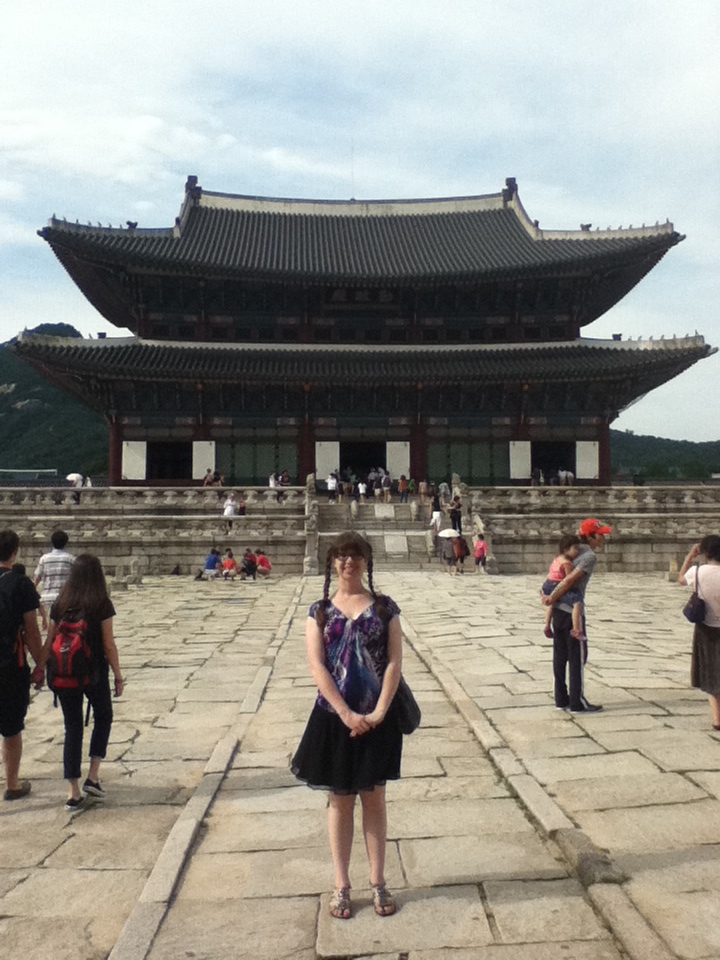
Me at the Gyeongbokgung Palace in Seoul, South Korea. Note my whimsical attire.

I don’t know if you remember, but a few weeks back I wrote a post about my super awesome book editing kick-off party. Three weeks later (also known as yesterday), we had the book editing wrap-up party. Merriment was had, alcohol was consumed, and many suggestions were made about how to make my book the best it can possibly be. A lot of them were very specific to my book, but I thought I’d share some of the more general wisdom here with you.

1. For a traumatic event to be believable, the character’s reaction has to fit the situation. Obviously ever character will react differently to a traumatic event, but never underestimate the impact of a good emotional breakdown. Or several.

2. Use the 5 stages of grief. To remind you, those stages are: denial, anger, bargaining, depression, and acceptance. The 5 stages of grief are used in everything from high-brow literary fiction to bad TV sitcoms, and there’s a very good reason for that.

3. Blue-raspberry jello tastes delicious with cinnamon sprinkled on top.

4. Check your facts. Otherwise you run into the embarrassing situation of a reader telling you that something you wrote was totally, unbelievably wrong.

5. Your characters can’t take everything for granted. Having your character encounter an enigmatic person or a ridiculous situation and grow accustomed to the oddity is fine, but make sure they are appropriately incredulous at first. Even if it’s something as simple as them asking, “Wait, why are you helping me?”. They don’t even need to receive a response – it’s just human instinct to question what we don’t know or understand. Unless you’re writing about something non-human, in which case you can do whatever the heck you like.

6. Be careful when you write about religion. People get really worked up over religion, and you don’t want to mess with that unless you have a very good reason for doing so.

7.  Too much or too little description of the love interest is bad. You want to give just enough description to let the reader form a picture in their mind of the character, but not enough that there’s no room for them to let their imagination run free. That’s a problem that book-to-movie adaptations run into all the time. A character is way over-described in a book, like: “6 foot 3, short blonde hair, emerald green eyes, straight nosed, full lips, broad forehead, square jaw, muscular, faint scar on the shoulder blade, etc.”, and then fans get all riled up when a hipster brunette is cast in the role.

8. Don’t let conflicting opinions weigh you down. People disagree all the time, and I guarantee that they will find things to disagree about when reading your book. The best advice I can give is to listen carefully to all sides of the argument, then make an informed decision on how to proceed based on your own opinions. This might annoy the people you’re disagreeing with, but ultimately it’s your book, and you get veto power.

Once I get all my proofread copies of the manuscript back, I’ll sit down for the FINAL EDITING ROUND, because I’ve been working on this book for six years now and it’s quite about time that I get it published and move on with my literary life. If anyone has any editing advice for me before I start the FINAL EDITING ROUND, or wants to weigh in on the post, or on my whimsical outfit, I’d love to hear from you!

Around the Interwebs:

Categories: Writing | Tags: , , , , , , , | 10 Comments

3 Awesome Things To Get You Through Friday

Friday is awesome because it’s the last day of the week, but it also sucks because you have to get through the entire work day before you can enjoy your weekend. Here are some fun things I’ve found around the internet that put a smile on my face. Hopefully they’ll cheer you up, too!

#1 I Take It You Already Know

I take it you already know
Of tough and bough and cough and dough?
Others may stumble, but not you,
On hiccough, thorough, lough and through?
Well done! And now you wish, perhaps,
To learn of less familiar traps?
Beware of heard, a dreadful word
That looks like beard and sounds like bird,
And dead: it’s said like bed, not bead –
For goodness sake don’t call it deed!
Watch out for meat and great and threat
(They rhyme with suite and straight and debt).
A moth is not a moth in mother,
Nor both in bother, broth in brother,
And here is not a match for there
Nor dear and fear for bear and pear,
And then there’s dose and rose and lose –
Just look them up – and goose and choose,
And cork and work and card and ward,
And font and front and word and sword,
And do and go and thwart and cart –
Come, come, I’ve hardly made a start!
A dreadful language? Man alive!
I’d mastered it when I was five!

#2 Star Wars Gangsta Rap

#3 The Avengers, Abridged

Note: This is an excerpt from the script. To view the entire script, click here.

The HEROES decide to bring TOM HIDDLESTON back to their BASE, because apparently DUE PROCESS applies to TRICKSTER GODS as well. Suddenly, CHRIS HEMSWORTH shows up and chastises TOM.

CHRIS HEMSWORTH

I have come to stop you, brah!

(pause)

Er, I mean, do I look to be in a gaming mood? Betwixt! Verily!

TOM HIDDLESTON

Brother, it must have taken every ounce of the All-father’s hurberble to plugurble you back to Earth. Let’s discuss it no more.

Suddenly, HEMSWORTH, EVANS, and ROBERT look around and notice it’s their first on-screen appearance together.

CHRIS HEMSWORTH

Quick, someone think of a super contrived reason for us to fight!

ROBERT DOWNEY JR.

I’ll fight you because you want to fight your brother, who I also want to fight!

CHRIS EVANS

And I’ll fight you both because I want you to stop fighting!

They proceed to act out their STATS from THE AVENGERS COLLECTIBLE TRADING CARD GAME and establish they are all EXACTLY EQUAL IN POWER, somehow. Guy on steroids, genius in a robot suit, invincible deity: basically identical.

CHRIS EVANS

Hang on a second, your hammer has decimated everything you’ve ever hit with it, you had no way of knowing my shield or Robert’s armor would protect us. Did you just attempt to straight-up murder us? Don’t change the scene, I want an answer to thi–

Happy Friday!

Categories: Random | Tags: , , , , , , , , , , , , | Leave a comment

Self-Publishing a Free eBook + Party Rock Cantina

Today’s topic is a very subjective one, as everyone I’ve met seems to have different opinions on releasing free eBooks. The concept of free-publishing (as I call it) is to get your name out there as an author in a format that everyone loves – free! On the flip side, as authors publishing our intellectual property that we have slaved over for years, we rankle at the idea of giving away our babies without any form of monetary compensation. Thus the debate: is it a good idea to publish a free eBook?

Why it’s a good idea:

People like free stuff. Online piracy is through the roof, with no indication that it’s going down any time soon. Odds are that if you publish a book, a good percentage of your readership will have downloaded it for free anyway. So why not take matters into your own hands and deliver it free of charge from the very start?

No one will buy a book from an unknown author. I’m not talking about indie authors, I mean authors that nobody knows about. So, logically, you need to become a known author before you publish a book. But how do you get known as an author of awesome books if you haven’t published anything? Catch 22, baby. Unless you publish free eBooks. Then you can spread your literary wings and get your name out there. People are far more likely to download something that’s free because, as I’ve already stated, people like free stuff. You don’t even have to write original fiction – several fanfiction authors I know of have had moderate success publishing original fiction using their fanfiction fanbase as a jump off point. So it’s really all about exposure, exposure, exposure.

It’s a great way to hook an audience onto a series. My mother’s rather rich, rather market-savvy friend, suggested that I release the first book in my Imminent Danger series for free. I didn’t listen to her, although perhaps I should have. Her reasoning was that if I can get lots of people to read the first one for free, they’ll be more likely to shell out a few bucks when the sequel drops. If you look at current best-sellers, the vast majority of them are part of a series. Fifty Shades of Grey, Twilight, Harry Potter, The Girl With the Dragon Tattoo, etc. You lose money at the start, but theoretically you’ll make it up in the long run.

Why it’s a bad idea:

You run the risk of being seen as just another free-eBook author. I don’t know about you, but when I see something offered for free, one of the first things that pops into my head is “What kind of quality can something given away for free really have?” It could be the greatest book in the world, but many people might have a hard time overcoming those sorts of thoughts. And the thought isn’t at all unfounded. Go to a site like Wattpad, where hundreds of thousands of authors post their books for free, and you get a sense of what I’m saying. There are a few real gems hidden there, no doubt, but the vast majority isn’t the greatest literature I’ve ever seen.

You don’t make any money. That sounds kind of haughty, but it’s true. When I was struggling over whether to self-publish with iUniverse or release the book for free, this was one of the main factors in my decision. Here’s my reasoning. Your book is your intellectual property, something you’ve poured your heart and soul into, and you deserve to market and sell it just like any other product. Sell it at a discounted price, because it’s a new book from a new author? Sure. Give free copies as part of giveaways or contests? Absolutely. That’s basic marketing strategy. But give it away for free? This is the same problem that you get when you discuss whether selling an eBook for 99 cents is too cheap. Your book is valuable. It is worth something.

There are other ways to gain fans. You don’t have to give away your book for free to get fans. What about contests and giveaways? What about social media and word of mouth? There are other ways to market yourself.

It ruins your chance for traditional publishing. I don’t know for sure about this one, but logic dictates that it’s true. Self-published authors get taken on by traditional publishers all the time. But what’s the point of a traditional publisher spending all that money releasing your book if you’ve already given it away to the entire world?

Ultimately, it comes down to personal preference.

Both publishing methods have their pros and cons. I myself am considering free-publishing a book I wrote a few years ago. It’s in a completely different universe from my soon-to-be-published Imminent Danger book, and while it’s a light, fun read, I don’t know if it has the staying potential to become a best-seller. It’s tempting to give it a good proof read and release it to the world, but as should be obvious from this post, I’m not sure if that’s such a good idea.

What do you think? Is free-publishing a viable option for self-published authors? Are the pros of free-publishing worth the cons? Have you ever free-published, and if so, was it a good experience? Did it gain you followers and friends that you wouldn’t have reached otherwise?

LMFAO goes Star Wars:

Image cred: http://www.fantasybooksandmovies.com/best-fantasy-books.html

Categories: Self Publishing | Tags: , , , , , , , , , , | 6 Comments

Ten Rules for Writing Fiction

In my eternal attempt to avoid doing work, I was once again meandering about the internet, looking for entertainment. I came across this article: Ten Rules for Writing Fiction.

What’s very cool about this article is that it doesn’t just give ten rules. It gives you ten rules from each of about a bajillion different authors from various genres and backgrounds. This means that some of the rules contradict each other, which I found very interesting. It goes to show that what works well for one author will have absolutely no relevance to another author. Writing is truly about personal taste, which is part of what makes writing such a daunting task — there is no “How To” guide that speaks individually to each author. You have to make up your own, and then tweak and refine your list until you figure out what works for you.

I’m not a famous author, but I thought I’d share my own Ten Rules for Writing Fiction with you. Partial credit for the list goes to Linda Schneidereit, my mother, muse, and mentor. Without further ado, here they are!

Michelle’s Ten Rules for Writing Fiction

1. Write to your audience. This means putting yourself in the reader’s shoes, imagining how they will react when they read your story, and using themes and language that are appropriate for that age and gender range. Don’t even think about publishing until you’ve gotten a real live member of your intended audience to proof read the book. They are a better judge of what they like than you are, so listen to them.

2. Write what you’re passionate about. This applies doubly to projects that require research. Some people can spend hours upon hours researching every detail of the historical era they’re trying to recreate. Others can’t. If you can’t, then don’t force yourself. Write something you know more about, something that won’t make you want to beat your head against a wall until you crack open your skull. Which leads into the next rule …

3. Whatever you do, don’t think of writing as “work”. If you do that, you’re sunk. Imagine getting home from your 8-10 hour work day, then sitting down at your computer and working three or four hours more. That’s not fun, and that won’t produce good writing. Stop writing, take a break, come back later. Writing is supposed to be enjoyable.

4. Don’t become too attached to any one part of your story. You’re going to have to change a majority of what you write, be it phrasing, character development, or even the entire plot. Loving your creation is a good thing, but smothering it with unwarranted affection is not. Be brutal with your edits. It will make your story better, and make you a better writer.

5. Get someone else to edit your writing. Preferably this will be someone with a literary background, who reads a lot, or even just someone who is fairly intelligent. Spell check won’t catch logical flaws or plot inconsistencies in your story any more than you will. Know why? Because you wrote it, and it makes sense to you — you wouldn’t have written it otherwise. It takes an outside opinion to point out the problems, and I guarantee you, there will be problems.

6. Make sure your characters speak uniquely. Each character should have their own voice. This could be something as simple as having an accent (Hagrid, anyone?), or something more complex, like using overly flamboyant language, or saying “like” a lot, or using poor grammar. Choose a passage of dialogue and take out the “he said” and “she said”s. If you can’t figure out who is saying what, you need to rethink their speech patterns.

7. Don’t bog things down with description. A paragraph explaining where the characters are is fine. Three pages of description is too much. How many people have read Lord of the Rings and skipped over page after page of descriptions of trees, rivers, and assorted scenery? Your reader needs to know where they are in the world you’ve created. That’s it.

8. Close your internet browser. It will distract you. Even YouTube can be harmful, especially if you’re not using a playlist. Open it if you need to research a fact or Google a name, then close it immediately.

9. Listen to music. Pay special attention to the lyrics. Musicians are story-tellers through song. Imagine the characters in your novel singing the words, then figure out why they are saying these things. Music evokes emotions in people in a way that few other things can, and it can serve as an excellent muse when you don’t know what to write next.

10. Don’t let other people bring you down. Sharing a great new story idea with someone, and having them flat-out tell you they think it’s terrible, or that they don’t like it at all, can be extremely disheartening. Remember that you’re the writer, not them, and that you can write whatever you damn well please. Even if they don’t like what you’ve written, or something you intend to write, there are over six billion people in the world. Odds are, you’ll be able to find an audience somewhere out there who’ll love your creation just as much as you do. So grab that keyboard, or pick up that pen, and get writing!

I’m sure I have many more rules floating around in my head, but these are the ones that come to mind. I’d love to hear your own list of writing rules, so please feel free to leave them in the Comments section, or provide a link back to your own blog. And check out the article link, because there are a lot of really great tips buried amongst the hundreds of writing rules.

Awesome pic of the day:

Categories: Writing | Tags: , , , , , , , | 12 Comments

Blog at WordPress.com.