Posts Tagged With: editing

So close to submitting my manuscript!

You’ve been listening to me whine about how much I dislike editing for the past few weeks, but that’s all about to come to an end. Today I got my last proofread manuscript of Imminent Danger and How to Fly Straight into It back, which means that I officially have a final manuscript to submit to iUniverse! Woooo! Final, that is, until they have their editors look it over and give me a whole list of changes to make. But let’s not think about that right now.

So the manuscript is good to go. I have some preliminary cover art from a friend of mine, and I need to get him to sign over the rights to me so I can actually use his design. My author photo shoot was last week on the University of Western Ontario campus — I’ll post a pic when I get them from my friend — so that’s taken care of. As near as I can tell, all I need is the author photo and the cover art rights contract, and I’m officially set to publish!

Man, this feels good. At the same time it’s terrifying, because I’ve read very mixed reviews of iUniverse. I’m mainly publishing with them because they can get my book into an actual brick and mortar store, but I still want the process to go as smoothly as possible. I’ve liked my interactions with them so far, so hopefully it will continue. Fingers crossed!

I guess the next step is to submit everything, then wait for the editorial review to come back. That’s supposed to take a few weeks to a month, so I’ll have time to kick back and get some actual, paying work done. Then they format the book, inside and out, turn it into an ebook, etc. etc., and then it’s PUBLICATION TIME! That won’t happen until about September, of course. But considering that I’ve been editing Imminent Danger for six years now, 3 months isn’t a heckuva long time to wait.

Wooo!

Update on my website troubles

Remember that list of questions I posted about how Justhost works from this post? I tagged Justhost in that post. The next day, I got a phone call from a Justhost representative. It turns out they actually monitor posts that Justhost is tagged in. Which at first I thought was kind of creepy, until the Justhost rep (Joshua) sent me a super-detailed list of answers to all the questions I posted on my blog. No strings attached, just a “We noticed you had some questions, so here are your answers trololol”. How awesome is that? Talk about customer service! Anyway, I’m really thrilled with Justhost so far, so thank you to Joshua and Justhost!

Game of Thrones Awesomeness:

http://www.youtube.com/watch?v=rapo0h-RDnk

Warning: There’s some PG-13 stuff in that video, so don’t watch with your little ones in the room 🙂

♥          ♥          ♥          ♥          ♥          ♥          ♥          ♥          ♥          ♥          ♥          ♥          ♥          ♥          ♥

Image cred: http://hannahgracewalls.blogspot.ca/2012/02/codex-and-illuminated-manuscript-1st.html
Categories: My Works | Tags: , , , , , , , , , , | 3 Comments

8 Things I Learned from my Proofreaders

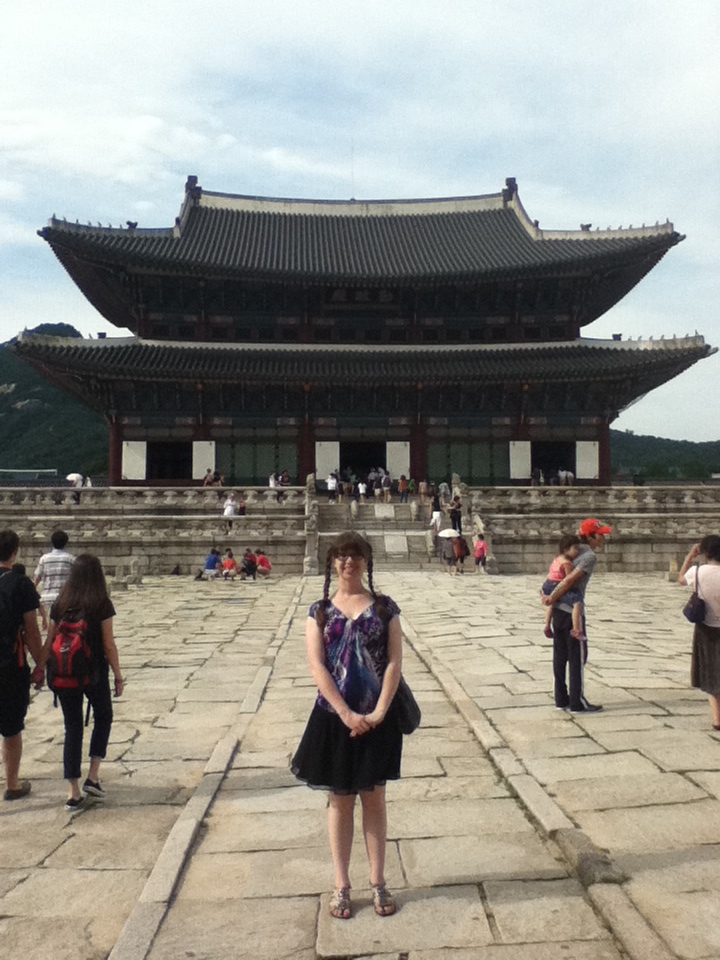
Me at the Gyeongbokgung Palace in Seoul, South Korea. Note my whimsical attire.

I don’t know if you remember, but a few weeks back I wrote a post about my super awesome book editing kick-off party. Three weeks later (also known as yesterday), we had the book editing wrap-up party. Merriment was had, alcohol was consumed, and many suggestions were made about how to make my book the best it can possibly be. A lot of them were very specific to my book, but I thought I’d share some of the more general wisdom here with you.

1. For a traumatic event to be believable, the character’s reaction has to fit the situation. Obviously ever character will react differently to a traumatic event, but never underestimate the impact of a good emotional breakdown. Or several.

2. Use the 5 stages of grief. To remind you, those stages are: denial, anger, bargaining, depression, and acceptance. The 5 stages of grief are used in everything from high-brow literary fiction to bad TV sitcoms, and there’s a very good reason for that.

3. Blue-raspberry jello tastes delicious with cinnamon sprinkled on top.

4. Check your facts. Otherwise you run into the embarrassing situation of a reader telling you that something you wrote was totally, unbelievably wrong.

5. Your characters can’t take everything for granted. Having your character encounter an enigmatic person or a ridiculous situation and grow accustomed to the oddity is fine, but make sure they are appropriately incredulous at first. Even if it’s something as simple as them asking, “Wait, why are you helping me?”. They don’t even need to receive a response – it’s just human instinct to question what we don’t know or understand. Unless you’re writing about something non-human, in which case you can do whatever the heck you like.

6. Be careful when you write about religion. People get really worked up over religion, and you don’t want to mess with that unless you have a very good reason for doing so.

7.  Too much or too little description of the love interest is bad. You want to give just enough description to let the reader form a picture in their mind of the character, but not enough that there’s no room for them to let their imagination run free. That’s a problem that book-to-movie adaptations run into all the time. A character is way over-described in a book, like: “6 foot 3, short blonde hair, emerald green eyes, straight nosed, full lips, broad forehead, square jaw, muscular, faint scar on the shoulder blade, etc.”, and then fans get all riled up when a hipster brunette is cast in the role.

8. Don’t let conflicting opinions weigh you down. People disagree all the time, and I guarantee that they will find things to disagree about when reading your book. The best advice I can give is to listen carefully to all sides of the argument, then make an informed decision on how to proceed based on your own opinions. This might annoy the people you’re disagreeing with, but ultimately it’s your book, and you get veto power.

Once I get all my proofread copies of the manuscript back, I’ll sit down for the FINAL EDITING ROUND, because I’ve been working on this book for six years now and it’s quite about time that I get it published and move on with my literary life. If anyone has any editing advice for me before I start the FINAL EDITING ROUND, or wants to weigh in on the post, or on my whimsical outfit, I’d love to hear from you!

Around the Interwebs:

Categories: Writing | Tags: , , , , , , , | 10 Comments

Ten Rules for Writing Fiction

In my eternal attempt to avoid doing work, I was once again meandering about the internet, looking for entertainment. I came across this article: Ten Rules for Writing Fiction.

What’s very cool about this article is that it doesn’t just give ten rules. It gives you ten rules from each of about a bajillion different authors from various genres and backgrounds. This means that some of the rules contradict each other, which I found very interesting. It goes to show that what works well for one author will have absolutely no relevance to another author. Writing is truly about personal taste, which is part of what makes writing such a daunting task — there is no “How To” guide that speaks individually to each author. You have to make up your own, and then tweak and refine your list until you figure out what works for you.

I’m not a famous author, but I thought I’d share my own Ten Rules for Writing Fiction with you. Partial credit for the list goes to Linda Schneidereit, my mother, muse, and mentor. Without further ado, here they are!

Michelle’s Ten Rules for Writing Fiction

1. Write to your audience. This means putting yourself in the reader’s shoes, imagining how they will react when they read your story, and using themes and language that are appropriate for that age and gender range. Don’t even think about publishing until you’ve gotten a real live member of your intended audience to proof read the book. They are a better judge of what they like than you are, so listen to them.

2. Write what you’re passionate about. This applies doubly to projects that require research. Some people can spend hours upon hours researching every detail of the historical era they’re trying to recreate. Others can’t. If you can’t, then don’t force yourself. Write something you know more about, something that won’t make you want to beat your head against a wall until you crack open your skull. Which leads into the next rule …

3. Whatever you do, don’t think of writing as “work”. If you do that, you’re sunk. Imagine getting home from your 8-10 hour work day, then sitting down at your computer and working three or four hours more. That’s not fun, and that won’t produce good writing. Stop writing, take a break, come back later. Writing is supposed to be enjoyable.

4. Don’t become too attached to any one part of your story. You’re going to have to change a majority of what you write, be it phrasing, character development, or even the entire plot. Loving your creation is a good thing, but smothering it with unwarranted affection is not. Be brutal with your edits. It will make your story better, and make you a better writer.

5. Get someone else to edit your writing. Preferably this will be someone with a literary background, who reads a lot, or even just someone who is fairly intelligent. Spell check won’t catch logical flaws or plot inconsistencies in your story any more than you will. Know why? Because you wrote it, and it makes sense to you — you wouldn’t have written it otherwise. It takes an outside opinion to point out the problems, and I guarantee you, there will be problems.

6. Make sure your characters speak uniquely. Each character should have their own voice. This could be something as simple as having an accent (Hagrid, anyone?), or something more complex, like using overly flamboyant language, or saying “like” a lot, or using poor grammar. Choose a passage of dialogue and take out the “he said” and “she said”s. If you can’t figure out who is saying what, you need to rethink their speech patterns.

7. Don’t bog things down with description. A paragraph explaining where the characters are is fine. Three pages of description is too much. How many people have read Lord of the Rings and skipped over page after page of descriptions of trees, rivers, and assorted scenery? Your reader needs to know where they are in the world you’ve created. That’s it.

8. Close your internet browser. It will distract you. Even YouTube can be harmful, especially if you’re not using a playlist. Open it if you need to research a fact or Google a name, then close it immediately.

9. Listen to music. Pay special attention to the lyrics. Musicians are story-tellers through song. Imagine the characters in your novel singing the words, then figure out why they are saying these things. Music evokes emotions in people in a way that few other things can, and it can serve as an excellent muse when you don’t know what to write next.

10. Don’t let other people bring you down. Sharing a great new story idea with someone, and having them flat-out tell you they think it’s terrible, or that they don’t like it at all, can be extremely disheartening. Remember that you’re the writer, not them, and that you can write whatever you damn well please. Even if they don’t like what you’ve written, or something you intend to write, there are over six billion people in the world. Odds are, you’ll be able to find an audience somewhere out there who’ll love your creation just as much as you do. So grab that keyboard, or pick up that pen, and get writing!

I’m sure I have many more rules floating around in my head, but these are the ones that come to mind. I’d love to hear your own list of writing rules, so please feel free to leave them in the Comments section, or provide a link back to your own blog. And check out the article link, because there are a lot of really great tips buried amongst the hundreds of writing rules.

Awesome pic of the day:

Categories: Writing | Tags: , , , , , , , | 12 Comments

Create a free website or blog at WordPress.com.